Happy Thanksgiving!

th-1104_happy_thanksgiving_valley_view_low

For all who celebrate this day, have the happiest of Thanksgivings! For those who live elsewhere, it’s still a good day to stop and count your blessings! Thank you ALL for helping build this site into something where writers everywhere can enjoy meeting fellow writers, share their own experiences, and learn from each other!

Sounding a note of thanks for this community

It’s Thanksgiving morning, and I would be spending time quietly reflecting on all the wonderful things in my life if only my niece and nephews weren’t standing on the second floor launching pillow missiles at me here in the living room. When I went around the room to ask them what they were grateful for, one of them gave me a canned answer like “my family,” but the other two came clean and said, “my iPad” and “cheese puffs.”

Much as I appreciate the simple abundances in my life–food, a roof over my head, my health –what I appreciate most are my relationships. They fuel every aspect of my life, every single day. My gratitude encompasses the relationships I’ve formed through writing in general and this space in particular, a place where creativity and generosity abound.

Thanks to Marcia for starting this place that encourages writers to help one another, a practice that certainly ought to become tradition.

Teaser Tuesday: Siren

I have been dreadfully absent for the last week. I took a little stay at home vacation from the internet and writing to indulge in a video game I’ve been waiting for what felt an entire lifetime to play. It was incredibly inspiration and my mind is abuzz with so many plots and plans.

Now I have so many things that need to be done, I have no idea how I will find time to do them all. It’s kind of thrilling when that happens, though, right? Inspirations knocking at the door, all the little voices clamoring to be heard and done justice on the page. I also have a ton of editing to do, but I’m easing my way back into it all, and while it’s always a dread leaving a vacation atmosphere, even an imaginary one, it’s good to be back to work.

I wanted to share another Teaser Tuesday with you all. I think this one is, by far, my favorite of them all to date.

siren promo 3

If you’re interested, you can pre-order your copy of Siren from Amazon, or grab a signed paperback from my site. If you do pick one up, I’m holding a weekly drawing, which you can find out more about over on my site.


Convince your reader to take a leap of faith (instead of a flying leap)

image By Ned Hickson

Writing must ring true with readers for them to become emotionally invested. This is particularly important when it comes to fiction, where you are often asking readers to suspend their disbelief and buy into something — such as an eccentric character, over-the-top situation or random reference to the new iPad6® in hopes of getting a free one — that requires a leap of faith. In this case, your reader is making a “leap” over reality because they have faith that you, the writer, will keep them safely suspended until they land safely on the last page. Assuming, of course, your book doesn’t end with, “…Then there was a massive explosion and everybody died, including the basket of puppies.”

As with taking any kind of leap, you must first gain momentum through a series of confident and quickening footfalls along a solid foundation. This applies to your writing as much as it does, hypothetically speaking, to clearing the front fence of your home in order to beat your son to the restroom after a long car ride. Without the right amount of momentum, your reader could end up — again, hypothetically speaking — doing the splits on a picket fence.

The most effective way for a writer to build a reader’s momentum toward a solid jumping-off point is through writing that resonates with an underlying honesty. This doesn’t mean confessing how you re-named areas of Mrs. Flunkem’s 7th-grade world map with parts of the reproductive system. Although changing “Panama Canal” to “Fallopian Tube” is worth mentioning, hypothetically speaking of course. No, when it comes to honesty in fiction writing I’m referring to what I like to call the “Double-D” approach, and not for reasons you might think. In this case we’re referring to “dialogue” and “description” that ring true enough to establish believability — and lay the foundation of confidence your reader will need when asked to make that leap with you. This applies equally to completely fictional characters, real people written within a fictional context (such as my “interviews” with Kevin Spacey and Clay Aiken), and the persona we project on our blogs and social media sites.

Dialogue is used to convey many things, from mood to information, plot points to character profiles. Because writing dialogue is complex and deserves its own post, today I’m focusing specifically on ways to make your dialogue — whether character driven or as author narrative — ring true and build trust with your reader. In a later post, we’ll talk about the difference between “telling and showing,” avoiding too many “he said, she said” references and the common mistake of nonsensical “action” dialogue (“Then I’m LEAVING!” he yelled, slamming the door on her still-parted lips poised in reply…)

*rubs lips*

Also, for purposes of this post, the subject of “description” will be limited to building believability in your character by effectively describing their actions. We’ll save descriptive passages like “The sun was setting in the canyon like a giant navel orange into God’s fruit bowl…” for another time.

Dialogue: It’s one of the fastest ways to earn — or lose — a reader’s trust. Whether it’s your voice as a blogger or words spoken by someone in a story, you are essentially having a conversation with your reader asking them to “believe.” And just like that guy at your office who is always talking about his nights of crazy sex when, in fact, you took your kids to the dollar theater Friday night and saw him sitting alone watching “Frozen,” you know he’s full of Whoppers. The same goes for your readers.

Unless they’re too busy singing “Let It Go.”

Assuming they aren’t, possibly because they have been shot, here are three tips to writing dialogue readers can believe in:

1) When writing narrative dialogue, don’t allow yourself to fall into “lecture” mode. We don’t like it from our parents, teachers, bosses, ex-wives, etc., and readers don’t either. Always keep your reader in mind. Pause every few paragraphs or minutes, depending on how fast you type (total elapsed time for this paragraph: three days) and ask yourself, “If I was having this conversation on the street with a stranger, what would they be thinking right now? Would they have questions? What feedback would they have? If someone drove by on a motor scooter, would they yank them off and steal the scooter just to get away?” You are building a relationship with your reader and, as with any good relationship, the other person needs to feel acknowledged. You can do this many ways, including throwing a question directly into your narrative.

See what I mean?

It’s a way to break out of the lecture mode and invite them into the conversation. Another approach is specifically stating the question they might have…

I know what you’re thinking: Is he always this verbose, or is it the coffee?

Narrative “dialogue” should be just that: Narrative that makes your reader feel included or acknowledged in the conversation, which builds trust.

2) Dialogue from a real person within a fictional context is simultaneously easy and extremely difficult. I say this because, on one hand, you have the nuances of their dialogue pattern already established in television and magazine interviews; it’s simply a matter of studying the way they speak and incorporating it into the dialogue you are creating for them. On the other hand, if you get it wrong, every reader will know it immediately.

I’m not buying it. Angelina Jolie would never refer to her children as “My little sucklings.”

In this case, you have to think of your dialogue as a caricature, making sure to include specific details of the person’s speech pattern — choice of words, cadence, vocabulary — that are recognizable as theirs. Just like how a caricature artists relies on key physical traits that distinguishes one individual from another, you must do the same when sketching out dialogue representing a famous person. Even if you don’t regularly “interview” famous people like I do (at least until there’s an injunction), it’s a great writing exercise that forces you to analyze all the nuances of dialogue.

Or as Angelina Jolie would say, “Go ahead — Make my day.”

3) Writing character dialogue that rings true and earns a reader’s trust really comes down to one basic principle: Consistency. I purposely placed this after “famous person dialogue” because many of the same rules apply. Though you’re writing about a fictional person, readers will recognize when you’re not being “true” to the character. When we meet new people, we instinctively study them to determine how far the relationship will extend. Acquaintance? Confidante? If there are inconsistencies in their behavior, such as explaining how they own a Porsche dealership yet leave the bar driving a 1987 Ford Fiesta, we tend to question their honesty. The same goes for character dialogue. Readers study it and quickly form an opinion. If the character’s vocabulary isn’t consistent, or they speak in bullet points one minute then in long Shakespearian soliloquies the next, you’ll lose your reader’s trust.

‘Tis truth I speak.

So take time to determine the nuances of your character’s speech pattern in the same way you would with their physical appearance and backstory. Or backside. Or whatever.

This is officially the longest post of my life. If you’ve made it this far, I thank you for taking this leap of faith with me. If you didn’t make it this far, then I can call you a big jerk and you’ll never know.

Next week, we’ll continue with “Description,” and tips on how it can enhance dialogue and build trust with your readers that will make them want to take a leap of faith — instead of a flying leap.

imageNed Hickson is a syndicated columnist with News Media Corporation. His first book, Humor at the Speed of Life, is available from Port Hole Publications, Amazon.com or Barnes & Noble.

Question, Anyone…

Question-Mark-Man2

After reading about bundles and funnels for building sales, I think I really like the concept. I want to do something along those lines. Trouble is, the book I’ll be releasing next is only Book 2 in the Wake-Robin Ridge series, so I’m not sure how to go about it. I think what I want to do is offer Book 1 free in conjunction with Book 2. But that’s hardly a bundle. How would I go about doing this? Would I combine both books in one document, making clear that Book 1 is being included at no extra cost? That seems like the easiest way, but I’m not sure if it’s the best way. What am I overlooking? Anyone?

Just A Reminder

Please remember to share posts like Aimee Easterling’s latest two-parter. Reblog, post on Facebook, or Tweet, if you can. This information is SO worth sharing, and it will help build more traffic here on TWS, so more folks will see YOUR posts and promos, too.

Writers Helping Writers by sharing. Thanks!!

Paid book promotions worth their salt, part 2

Despite the Billionaire's RichesIf you missed my first post on the subject of paid book advertising, head over here first to get caught up. The short version is: the most sure-fire way to advertise books is to get your title included in one (or more) of the email lists that go out to thousands of readers on a daily basis. My previous post mentioned a few websites that will list your book for free, while this second installment will delve deeper into the paid sites that are most likely to provide a return on your investment.


The big dogs

If you hang around with other independent authors for long, you’ll soon hear them singing the praises of Bookbub. Although this advertising service costs hundreds of dollars a pop, most folks find that Bookbub provides a positive return on your investment, and if you play your cards right, your book might even end up in the top 100 in Amazon’s store after being listed! Unfortunately, there are big hoops you need to jump through to be eligible, and Bookbub rejects a lot more submissions than they accept. So, if you can’t get into Bookbub (or can’t afford their high fees at the moment) where do you turn next?

In Write. Publish. Repeat. the authors explain: “We’ve had the most luck with BookBub.com, EReaderNewsToday.com, and FKBooksAndTips.com’s 99-cent promotion programs. We’ve also had lesser but substantial success with Bookblast.co (.co, not .com) and BookGorilla.com.” Let’s Get Digitial Author David Gaughran weighs in as follows, “After BookBub, the next biggest sites are Ereader News Today, Pixel of Ink, BookSends, and Kindle Books & Tips,” before warning that the value of promotional opportunities changes fast, and to do your research before plunking down any money. Sure enough, Pixel of Ink is not currently accepting submissions at this time.

There are also a lot of smaller advertising sites that I’ll mention later, but the smart thing to do if you’re committing to a paid promotion is to combine several promotions in short succession in an attempt to move up the ranks and stick there. The accepted wisdom is that you should first try to bring one of the big dogs on board, then you should plan the other services around the main event.


Preparing for the sale

Now it’s time for a healthy dose of “do as I say, not as I do.” The reports I’m going to present below are based on a promotional push I ran around the launch period of Despite the Gentleman’s Riches, and, with twenty-twenty hindsight, I’d do a lot of things differently. All of my previous books have been in the fantasy genre and (in contrast) Despite the Gentleman’s Riches is a contemporary romance, so I wasn’t prepared for my fans’ complete lack of interest (or outright disdain) for the new book. Previously, I’ve emailed my list to find interested readers a couple of weeks before launching a new title, had sent out review copies when I got the manuscript back from the copy editor, and had been able to count on at least 15 reviews averaging about 4.5 stars trickling in during the first week. Since you have to plan your promotions at least 14 days in advance, I just assumed similar reviews would appear on my new book in time for the blitz. Instead, several of my advance reviewers gave the book three stars, one of my preorder fans gave it one star (ouch!), and I went into the promotional period with a 4.2-star ranking. That doesn’t sound bad, but there’s a big visual difference between only four stars filled in versus four and a half, and fewer glowing reviews meant my new book had less perceived social capital. So, lesson 1 — don’t assume that you’ll have a great-looking product page soon after launch. A better idea would probably have been skip soliciting reviews from my fantasy-loving fans entirely, to let the book build reviews organically, then to pay for a promotional period at a later date when the book’s perceived social capital was high.

Similarly, I should have managed my pricing so that I was eligible for a countdown deal during the promotionary period. Most sale sites won’t accept your book unless it’s marked down to 99 cents, which you can either do manually or with a countdown deal, the bonus of the latter option being that for the five days of the countdown deal, you’ll receive a 70% royalty on the reduced-price book. However, since I’d been trying to get fans to consider a title outside their main genre during the preorder period, I launched the book at 99 cents, meaning that I had to make twice as many sales to break even with each ad (due to the 35% royalty). Again, raising the price to $2.99, waiting for the 30 days Amazon requires between price change and countdown deal, and then setting up a real sale would have been a better bet. As an added bonus, the countdown deal would have shown the higher price with a slash through it, so the customer would have known they were getting a great deal.

Summary: More patience on my part would have made this sale period go much more smoothly!


My experiences

Mistakes aside, my paid promotions are still likely to break even by the end of the month. I chose 13 paid promotional sites spread out across 13 days, paid $370.50 for the privilege, and (if borrows bring in $1.33 like they did in October), I will make $260.51 for the first 18 days that the book has been live. I could have brought in quite a bit more, though, if I’d focused on the winning sites and avoided some expensive losers, so I thought I’d report my results to keep your own costs down. (Of course, keep in mind that the results of each promotional site is likely to be genre specific, and that some sites probably attract readers who were more turned off by my lack of perfect reviews than others. But, still, this should help you get started.)
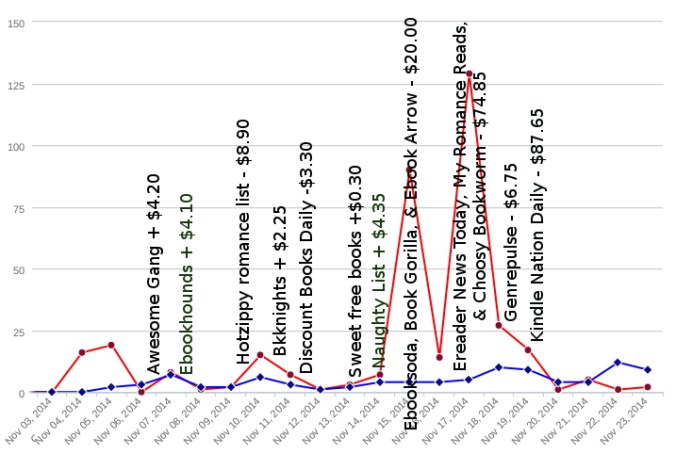
Results of paid book promotions

Okay, the chart above might look a little daunting, so let me give you a quick text rundown. The two sites listed in green (Ebookhounds and Naughty List) were both free, but their results were quite good, so I added them to the chart. The other advertisers were all paid, and I listed the net earnings from each, using the assumption that I wouldn’t have sold any other books that day without their help (not a big stretch since the book basically started at nothing). As you can see, some of the cheaper promotions — Awesome Gang ($10), Bkknights ($5), and Sweet free books ($5) did better than the more expensive options. I added the little guys on at the last minute as a way of bringing up the rank of the book before the supposed big dogs hit, since Amazon is supposed to reward slow, organic growth of a book’s sales better than a spike in the rankings from one big advertising blitz. (The former results in a good sales rank that is supposed to stick around longer than the latter.) But now I’m starting to think that lots of these little guys might be a better financial investment than a few of the supposed big dogs!

Because, unfortunately, I was much less impressed by the more expensive promotions that I paid for. I stacked most of the big dogs together, so I have to guess which ones were and weren’t worth the money, but I’ll give you my informed opinions here. Having tried two different $15 promotions through Hotzippy on two different books and lost money on both, I’m now relatively convinced that Hotzippy is not a good use of money (for me at least). I also suspect that Book Gorilla and Kindle Nation Daily (both by the same company) are too overpriced at $50 and $100 respectively to be worth the cash. Finally, since so many people sing the praises of Ereader News Today, I’m going to assume that the expensive My Romance Reads ($75) that I layered on the same day is why that period’s advertising didn’t break even.

And, finally, here’s the cheat-sheet version of the advertisers I at least tentatively recommend:

Ereader News Today — Prices range from $15 to $45 at the moment, depending on genre. Sometimes called “the little Bookbub”, ENT is pretty choosy but is usually considered to be worth the price tag.

Free Kindle Books and Tips — 99-cent books cost $25 to advertise. They do waive their review restrictions for new releases, but they only send out new-release notices on weekends. I didn’t sign up for these guys because I didn’t notice the new-release option when I was first researching, so I have no first-hand data to report.

Booksends — Costs $10 to $50 for a 99-cent book depending on genre. They rejected me, so I can’t report any results.

Awesome Gang – $10

Bknights – $5.50

Fussy Librarian – $5 to $14, depending on genre. I somehow got my wires crossed on setting up my ad for this particular book, but have used them before and broken even.

Sweetfreebooks – $5


The good news of a “failed” promo blitz

Even though I came out a hundred bucks in the hole, I would definitely repeat this experience, with all of the caveats listed above (and a few more that I’ll mention in a minute). I’ve had nine new subscribers join my email list during the promo period, have already landed two new reviews (a four star and a five star — so my book doesn’t suck after all!), and the book seemed to be sticking pretty high in the rankings for at least a while after the promo period ended. Plus, more borrows have been landing in my dashboard daily, suggesting that I’ll be raking in the results of the sale-period visibility for at least a few more days to come.
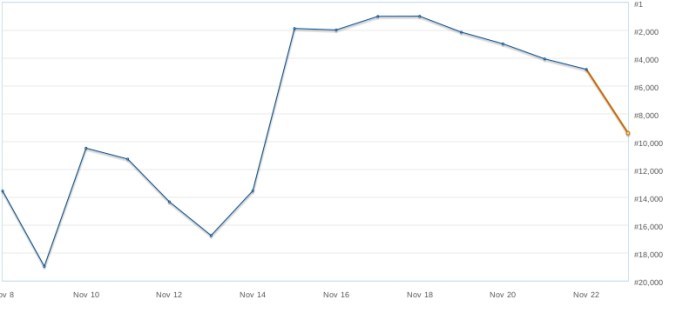
Sales rank during a promotional period

Aside from dressing my book in its Sunday best before the promo, doing a countdown deal, and skipping the overpriced advertisers, what else would I do differently? Paid promotions are most likely to actually make money rather than just break even if you advertise the first book of a completed series. I’ll try out this hypothesis on Shiftless once Pack Princess comes out in about a month, and for this second experiment I’ll see if Bookbub will take my novel to the prom.

That said, I’m starting to think that a free period might have been a less expensive way to get Despite the Gentleman’s Riches off to a good start…and without spending a penny! So, perhaps the moral of the story here is to be patient, to use a free period early on to give your book legs, and to save the 99-cent advertised promotions for later in the life of a book.

Okay, I know this post got way too long (again!), but if you’re still with me, I hope you’ll leave a comment with your own advertising results. Do you agree on which promotions are and aren’t worth your money? Did you advertise a book in a different genre and see different results? Let us know so we can all save some cash next time around!
We all know we need to build a platform, but how many planks does it need?

I had lunch one day last February with my brother’s boss, a high-level marketing guy for a company whose product is wildly popular. He also co-authored and self-published a business book that did so well the Big Bookstores picked it up, so I wanted to pick his brain about what I could do to get my writing out into the world beyond my blog. I explained that, though I blogged fairly regularly, I didn’t do much to try to promote it.  The real focus of my writing efforts was a quasi-memoir that revolves loosely around my relationship with the first house I owned. I wanted his thoughts on how to pitch the quasi-memoir, which at the time was 70% complete, to agents, publishers, etc.

He held up both of his hands and said, “Wait a minute, Karen, you haven’t published anything yet, have you?” I shook my head. “Then you’re doing this all wrong.”  He went on to tell me I needed to build a platform and find a way to generate demand for the quasi-memoir even before it was written. This seems like such obvious advice, especially since my minimal efforts to promote my blog guaranteed that it hadn’t been seen by anyone who doesn’t share my DNA. He suggested that I read a marketing book that’s oh-so-helpfully called Platform.

I greet business books with the same enthusiasm as I do tax returns, so I won’t lie and tell you I read it in great detail. I skimmed it, focusing on the areas that interested me most and skipping right over duh counsel like “create great content.” The insights I gleaned from the book led me to crank out the collection of humor essays that I self-published on CreateSpace and released on Nov. 4. But doing all of that still isn’t enough, because you have to promote it.

Which is how I find myself staring down Day 23 of Shameless Self-Promotion Month. (Happy SSPM, everyone!) I understand that, no matter what you’re “selling,” you must have a social media presence. But how do you figure out where to allocate your time without cutting into your precious writing time, especially if you, like me, have a non-writing full-time job? Do you choose only two or three outlets –facebook, twitter and Goodreads, for example–and focus on those? Or do you try to touch them all and then stick with the ones where you get traction?

And I would especially love to hear from anyone who has figured out how to make sense of what feels like cacophony to me on Twitter. I know people form relationships and connections there all the time but I don’t quite understand how that happens when so much content is flying around so quickly.

Hoping to hear from all of you wonderful folks out there!

To Plan, or Not to Plan?

question-mark-8-xxl

That is my question. A certain part of my brain thinks planning is very uncreative, and that writing, like any other form of art, should be a spontaneous thing, like mold growing on an old shower curtain. (Okay, eeww.) Another, more practical, part of my brain says having a Plan…capital “P”…is usually a good idea. Trouble is, I’m at war over the issue.

Without a Plan, I tend to flounder, wait until the last minute to do things, get off track and spend too much time doing other, non-productive, stuff…things like that. Yet, with a Plan, I immediately rebel, and start to drag my heels, feeling forced to do one thing, when I really want to do something else. Having a Plan tends to stomp all over my enjoyment of things, like writing. So it’s a Catch-22 thing for me, and mostly I’ve been ignoring the whole issue. But recently, I realized my whole life was out of control. Too much freedom was actually keeping me from being as creative in my work as I wanted to be, because it was keeping me from focusing on anything. So I decided to write out a 5-year Plan, based on my personal needs at this time of my life, and incorporating some of the things I’ve been reading about.

My Plan is simple. It consists of Two Parts:

Part 1: Write ten decent books in 5 years.
Part 2: Learn some marketing techniques and tactics that don’t keep me too busy to accomplish Part 1. 

That’s pretty much it. Simple. Direct. Easy. Doable. And yet, I immediately felt the pressure. When I say I work anywhere from 8 to 12 hours a day writing or doing writing related tasks, I’m not kidding. And that’s a lot of work for most of us, but especially for those of us who are feeling the effects of the aging process more each year. Sitting that long at my computer is difficult at best, and downright painful at worst. No need to go into all the aches and pains in detail, but believe me, they are there, keeping me awake at the end of the day. And don’t even get me started on my vision issues.

The point is, I end up trying to do more and more, faster and faster, in less time, so I don’t have to spend so long at the computer at one time, yet hoping I still have a chance to meet the goals laid out in my plan. And then…surprise!…I get tired, frustrated, and stressed, and fall  even farther behind.

My solution was to accept that my Plan is merely a goal–something to aim for, not something carved in stone that can’t be deviated from. I can allow myself to work toward this goal, yet stop punishing myself when I fall short. I think my Plan is a good one, doable at a rate of two books a year. But I can’t set myself up for failure, by insisting I work ridiculously long hours that exhaust me both physically and creatively.

My Plan is now a flexible one, which gives me a sensible, attainable goal to work toward, with room for improvising built in.

Do you have a plan? If so, is it working for you? Keeping you on course, yet allowing for detours in the road? I’d like to know what’s working for you guys, and what’s not. Hope you’ll share some thoughts with us.