Coming out to the ones you love about your alternative (writing) lifestyle

image By Ned Hickson

It began with my parents of course, who held hands as I explained that I had always felt “different,” and that I wanted to embrace who I was, without shame, hopefully with their acceptance and approval. They both exchanged glances, my mother squeezing my father’s hand and offering him a worried smile before turning back to me. She knew what was coming and slowly blinked, nodding her head ever so slightly, encouraging me.

I cleared my throat. Took a deep breath.

“Mom… Dad… I think I might be a writer.”

It’s been many years since I came out of the closet. Or, in my case, the laundry room, which is where I did most of my writing until becoming a columnist in 1998. But before that — before I actually started getting paid to write — that conversation replayed itself many times over the years with family, friends and co-workers, most of whom thought of my writing as something akin to collecting salt and pepper shakers; a “unique” hobby that I was asked not to talk about at parties.

“Don’t take this the wrong way, but for people who don’t know you — it makes them uncomfortable when your eyes light up like that.”

The bottom line is that no one took my writing seriously (And, yes, I realize the irony of that statement considering I am a humor columnist, but still…). In retrospect, there were many reasons why my wanting to be a writer was perceived as a bucket list item instead of a legitimate rung on my life ladder — beginning with my own perception of “wanting to be” a writer. Because we’re conditioned from an early age to view money as a prime indicator of success and achievement, we naturally use that same measuring stick as validation when it comes to pursuits that don’t fall into traditional categories.

In short: If you aren’t getting paid for it, then you’re not legitimate.

That’s like saying you can’t include “skydiving instructor” among the achievements in your obituary just because your parachute didn’t open the last time you jumped. Even if you’ve landed flat on your face in terms of monetary or publishing success with your writing, it doesn’t mean you aren’t a writer.

It just means there’s a good possibility that every publisher you’ve submitted your work to was a skydiving instructor who died before they could read your masterpiece. I honestly can’t tell you how many publishers plunged to their death before I saw my first words in print.

Regardless, if you spend time formulating words for the sheer enjoyment while, at the same time, agonizing over those very same words, congratulations:

You are a writer.

How do I know this? Because no one who isn’t a writer would put themselves through this process. Ask the average person on the street to write five paragraphs about their favorite memory while holding them at gun point, and most will help you squeeze the trigger. The ones who don’t?

They’re the writers.

Or masochists. Which I realize is somewhat redundant.

My point is the only legitimacy you need as a writer comes from yourself — and it starts with believing what you do is important and has value that isn’t measured in dollars or even common sense in the eyes of others. Let’s face it, toiling alone over the choice and arrangement of words on a page doesn’t make much sense to anyone who isn’t a writer. They may nod their heads and smile when you try to explain it, but in their minds they’re wondering if buying a home so close to high-voltage power lines was a mistake. Again, the only thing that matters is giving yourself permission to take your writing seriously.

And by “serious,” I don’t just mean getting published or paid for the words you write. It simply means serious enough that you make time for it, in the same way you do other routines that are important to your daily life.

If you take your writing seriously, so will others.

And if they don’t? It doesn’t make you any less a writer. Published or unpublished, novelist or columnist, fiction or non-fiction, accept yourself for being a writer and always make time for putting those words down on paper. It is both a gift and a responsibility — and a pursuit that is uniquely your own to determine and discover. Make it part of your lifestyle and treasure those who embrace it with you.

As for everyone else?

I hear that skydiving makes a great holiday gift…

_______________________________________________________________

image

Ned Hickson is a syndicated columnist with News Media Corporation. His first book, Humor at the Speed of Life, is available from Port Hole Publications, Amazon.com or Barnes & Noble.

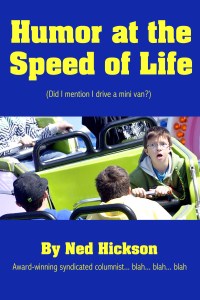
An excerpt from ‘Humor at the Speed of Life’ by Ned Hickson

image

I believe some introductions are in order. And by that, I mean the introduction in my book, which seems like a good place to start. Given that Humor at the Speed of Life is a collection of my newspaper columns, I felt the need to give readers a little background as a jumping off point. Hoping, of course, that they weren’t reading it while perched on the ledge of a building…

***

THIS JUST IN…

After 15 years as a humor columnist, it finally hit me. And by that I mean my editor’s stapler. She had been threatening to throw it since 2004, when I first discovered the secret candy drawer she had cleverly labeled: Extra Work for Reporters. For the past nine years she had been warning me, “If you don’t stay out of my candy drawer, I am going to set this thing for ‘stun’ and hurl it at you!”

As I sat there, blurry-eyed and rubbing the back of my head, I came to an important and potentially life-changing realization:

I really need to publish this book now, before she gets a new stapler.

Once my editor replenished her candy stash, there was a good chance another direct hit would result in serious brain damage, ending my career as a journalist and leaving me to write for daytime television. The truth is, readers have been asking me for years to compile a book of columns. As one reader from Gwynette, GA., wrote in, “If you ever come here for a book signing, you better have pastries or something.” Continue reading

Tips to jump-start your writing (unless you’re in Arkansas)

imageBy Ned Hickson

There’s nothing quite like staring at a blank page, knowing that with a few strokes of the keyboard you will transform a landscape devoid of life into a living, breathing thing of your own creation. There’s also nothing quite like finishing that fourth cup of coffee only to find that same blank page staring back at you.

Sure, you may have typed several sentences — or maybe even the same sentence several times — in hopes of gaining some kind of momentum to carry you over that first hump, but the cursor repeatedly stalls out in the same spot, leaving you with the same blank page after riding the “delete” button back to the beginning.

Hey, that’s why it’s called a “cursor.”

I’ll be honest. I don’t necessarily subscribe to the notion of writer’s “block,” which suggests some kind of blockage — such as a cheese wedge or too many butter biscuits — restricting movement through a hypothetical colon of creativity. Although there are some books in print that offer evidence to support at least part of the colon theory, I prefer to think of the writing process as cells in a battery; when they are fully charged, things start easily. But if the alternator belt slips too much or the terminals get corroded, you end up without enough juice to turn the engine. Because we are writers and not mechanics, and because that last sentence exhausted the full extent of my automotive knowledge, I will sum up my analogy with this: When your battery is low, you get a jump, right?

Writing is no different. Continue reading

Forget that image of Bruce Jenner and start writing

write write write copy By Ned Hickson

I’m going to open with a simple truth:

Step one to being a writer: Write!

That advice seems pretty straight forward. The kind of obvious straight forwardness that carries you with complete confidence toe-first into a brick. Like most advice we’re given, the wisdom behind it is simple; the problem comes in the execution.

And while there are countless books out there offering tips on everything from how to get inspired and avoid writer’s block to the kinds of foods that promote creative thinking (which, judging from what I read, you will be doing mostly while on the commode), all of those books essentially come down to one universal truth:

Nothing promotes and stimulates writing better than…

You guessed it:

Excessive drinking.

But let’s suppose you don’t want to become an alcoholic? Does that mean you’re not truly committed to being a writer? Could it jeopardize your dream of becoming a novelist, columnist, short story writer or inner city tagger?

Let me answer those questions by answering the single most important question you’re probably asking yourself right now:

Has HE been drinking?

Of course not. At least not yet.

I have four children, remember?

Regardless, my point is that the other universal truth to writing is this:

The fastest way to jumpstart the writing process is to put your fingers to the keyboard and just start writing.

I purposely sat down to write this post without any preparation. I did this to 1) challenge myself, and 2) because I really had no idea what I was going to write anyway, so it seemed like a good plan. To that end, I started putting words on the screen.

Did I take a wrong turn or two?

Absolutely.

But the beauty of writing is that — like the Kardashians — nothing is permanent, and you can easily fix imperfections by injecting or removing the things you don’t like. And many times, what you thought was going to be a wrong turn or dead end leads to a doorway you hadn’t expected — or at least a window you can jump out of.

Especially if you walk in on Bruce Jenner getting a body wax.

OK, in an effort to move on quickly from that image, how about a show of hands from anyone who has ever found themselves staring at a blank screen with their fingers poised over the keyboard, even if they have applied my advice?

Seriously, I’m watching, so get them up.

I ask this because, in spite of my advice, there are still times when you need to jump-start your jump start.

Something I’ve discovered from writing a daily blog is that the interaction with other writers on blogs and websites — whether replying to a comment or leaving one on another writer’s site — is a great way to grease the creative process.

… Great, just when we had gotten past that image of Bruce Jenner…

Sorry, everyone.

Anyway, starting your day with some social interaction at your computer not only gets you into writing position at the keyboard, but can get the creative process started by reading others’ work, getting inspired by it, and formulating responses or comments in a creative frame of mind.

Warning: Set a time limit!

As I can attest, it’s easy to lose track of time, or become so caught up in commenting and replying that your momentum is carried in the wrong direction. I usually give myself until I finish my first cup of coffee.

Which, by the way, I have switched from the giant 128-ounce Big Gulp size to a standard mug. Not only because I was using it as an excuse to blog until noon, but also because I discovered my bladder only holds 120 ounces.

Bottom line, once you’ve established a writing routine, solidify it by putting words on the page — whether for your actual writing project or during a social network warm-up — each time you sit down at the keyboard. Before you know it, your writing will be waiting for you in your mental queue at the same time each day.

Assuming you can get the image of Bruce Jenner out of your mind.

Again, my apologies for that.

_______________________________________________________________

image

Ned Hickson is a syndicated columnist with News Media Corporation. His first book, Humor at the Speed of Life, is available from Port Hole Publications, Amazon.com or Barnes & Noble.

Tools for thought… or food for your toolbox… or something like that

image By Ned Hickson
A while back, I talked about three of the most important tools a writer wields when it comes to establishing their voice. Does anyone remember what they were?

For the sake of time, let’s just assume all of you remember what those tools were and, in a series of uncontrollable outbursts, begin shouting out:

TIMING!

TRUTHFULNESS!

and…

CUERVO!

No, the third tool is RELATIVITY — not Cuervo. Even though I think we can all agree Cuervo does have a way of making even the most abstract things seem relevant.

In this case, however, Relativity means ensuring the reader can relate to what we’re writing about. This is especially true when it comes to personal experience and family anecdotes. For example, that hilarious story about how Aunt Frida got mad and stomped through the garden won’t be nearly as entertaining to readers as it is to you unless, like you, they already know Aunt Frida was a mule. I realize that’s an overstatement, but unless you take time to lay the foundation of your story in a way that involves the reader, they will likely sit down and refuse to follow.

As for Timing and Truth, they’re pretty self-explanatory. In a nutshell, Timing is the use of punctuation and sentence structure to create a rhythm that enhances your storytelling, while Truth is exactly that: writing about what you know and, whenever necessary, doing the research to educate yourself about a topic before presenting it to your readers. For example, when I wrote about the first wedding proposal in space, I prepared myself by going through NASA’s extensive astronaut training program.

OK, fine. But I did do my research before writing about how awful the food would be at a space wedding, with puree’d roast beef and cedar-plank salmon from a tube, and how throwing rice would be a big mistake since, thanks to zero gravity, the wedding party would spend the rest of the evening surrounded by clouds of floating rice. And how do you spike the punch when it’s served in a squeeze box?

Now that we’ve re-summarized those first three important writing tools, here are two more:

Vocabulary
Economy

Vocabulary seems straight forward, right? A knowledge of words. But more important than knowing a lot of words — or big words — is knowing the perfect words. Think of it as the care you put into choosing the words to express your love for someone. Or quite possibly while trying to get out of a speeding ticket. In either case, there’s a lot riding on your word selection. One wrong word, or too many of them, and you could find yourself in hand cuffs. (I realize for some of you that might be the objective in the first case, but just play along.)

Let’s take a look at the last sentence a few paragraphs ago, about educating myself at NASA. What if I had written it like this:

…when I wrote my column on the first person to propose in space a while ago, I learned about the subject by participating in the astronaut program at NASA.

Here’s what I went with:
…when I wrote about the first wedding proposal in space, I prepared myself by going through NASA’s extensive astronaut training program.

The breakdown:
1) “…when I wrote my column” versus “…when I wrote about…” In the second instance, I’m assuming you already know it’s “my column.” I wanted to avoid another “me” reference and also improve the flow.

2) “…on the first person to propose in space a while ago…” versus “…the first wedding proposal in space…” We all know it’s a person who is proposing since there has been no reference to aliens or talking animals, so I didn’t feel it was necessary to refer to “the first person” proposing. Instead, I went with “first wedding proposal in space” since the proposal is the subject. Now, if alien or talking dog proposals were common place, then yes, I would make sure to clarify it was a person proposing. Hopefully to another person and not a talking dog. And I chose to completely drop “a while ago” because it really doesn’t matter when I wrote it, and trimming it cleans up the sentence.

3) “…I learned about the subject by participating in the astronaut program at NASA” versus “…I prepared myself by going through NASA’s extensive astronaut training program.” To get to the action of this sentence, I dropped “learned about” and “by participating in” and combined it into “preparing myself by going through,” then moved “NASA” closer to the action as a way to bring those two images together much faster. From that point, I built on the satire by describing what I did as “extensive astronaut training.”

Are you having flashbacks from eighth-grade sentence diagramming? Sorry about that. I hope the breakdown was helpful in offering at least some insight into the thought process of choosing the right words or, if nothing else, why my daughter won’t let me anywhere near her book reports.

Our last writing tool, Economy, is directly related to Vocabulary because choosing the right word can often mean fewer words. Economy is big part of the revision process, when you take a hard look at what can be eliminated from the literary structure you have created while maintaining its integrity. While this isn’t as important in novel writing, it is critical for columnists, short story writers and journalists. Every story requires being as concise as possible by using an economy of words. Ironically, as I say this, I just realized the current word count makes this my longest post ever.

Fortunately, Hypocrisy isn’t one of the tools we will be talking about today.

Alfred Hitchcock once said everything in a movie must have purpose and propel the story. If it doesn’t, it needs to be eliminated — which could explain the number of murders in his films. In short, when it comes to Economy, think of Alfred Hitchcock.

But probably not while you’re in the shower.

_____________________________________________________________________________________________________

imageNed Hickson is a syndicated columnist with News Media Corporation. His first book, Humor at the Speed of Life, is available from Port Hole Publications.)

A few things writers and superheroes have in common

image By Ned Hickson
As I’m sure you’ve already gathered from the title of this post, yes: I look really great in tights and a cape. At least on paper. In fact, all writers do. However, the power writers wield with words (such as using four “w” words in a row) — whether (make that five) for inspiration, contemplation or revulsion — got me thinking about the things writers and superheroes have in common. And I don’t just mean how often people confuse me for Chris Hemsworth. At least on paper.

To begin with, like any superhero, every writer experiences a transformation process before going into action. Sure, it doesn’t involve hastily peeling your clothes off to reveal a fancy costume (depending on your genre and dedication to research), or a blinding flash that changes you from street clothes to colorful tights — something for this reporters in my newsroom are extremely thankful. However, while not as dramatic, there is a transformation that takes place as a writer’s body language, facial expression and overall focus shifts from “earthbound” to “alternate universe.” Ever see a photo of yourself immersed deep in writer mode? It’s like looking at someone else. Which, in my case, is often mistaken for Chris Hemsworth. I mentioned the alternate universe part, right?

Speaking of which, like Thor’s mighty hammer, Spiderman’s web-shooters, Green Lantern’s ring or Hulk’s endless supply of purple pants, writers wield their own super-powered tool for getting the job done. I’m talking, of course, about a cranky editor. Haha! Just kidding! That will be next week’s NWOW topic: Things Editors and Super Villains Have in Common. Naturally, the super-powered tool I was referring to is the computer or tablet a writer wields as a defender of the written word. I realize some of you might be saying:

“I don’t write on a computer, so that’s not entirely accurate.”

And I suppose you’re right. The again, Moses was technically the first person to use a tablet, but let’s not split hairs.

Another characteristic that writers and superheroes share is having their powers thrust upon them. Like any superhero, a writer discovers their gift and realizes “With great power comes great responsibility to pick up a second job.” There’s no avoiding who your are, the powers you have been given, or finding the best way to use them. Bruce Wayne, Peter Parker, Jean Grey, Bruce Banner, Clark Kent — they all tried to deny their powers and the responsibilities they carried as a result of what fate had bestowed upon them. In each case, they came to realize they were only living within a shadow of who they were meant to be. The same goes for writers; they return to action because they can’t stop being writers.

So, does all of this mean you should should expect a call from The Justice League or S.H.I.E.L.D.?

Probably not. But as a writer, rest assured you are in the company of some really super friends.

(P.S. This one was for you, Marcia!)

_______________________________________________________________

image Ned Hickson is a syndicated columnist with News Media Corporation. His first book, Humor at the Speed of Life, is available from Port Hole Publications, Amazon.com or Barnes & Noble. He ic currently working on his next book, Ned’s Nickel’s Worth on Writing: Pearls of Writing Wisdom from 16 Years as a Shucking Columnist.

One of the biggest mistakes in my life? The time I quit writing

image By Ned Hickson
As I mentioned in the title to this post, there was a time I quit writing. Back in 2006. For almost a year.

It had nothing to do with the typical kind of frustrations every writer faces, such as not having a readership or being told it’s time to “get serious” with your life by family, friends or every publisher on the West coast. It wasn’t the result of drug addiction or alcohol abuse, although I did find myself addicted to watching Grey’s Anatomy, which made me WANT to drink.

Things were going well with my writing. My readership was growing and I had an agent working to get me signed with a large publishing house.

The problem came on my 40th birthday, when I was given the ultimate surprise gift: divorce papers and single parenthood. Though I can look back on it now and see it for the gift it was, at the time it was like George Clooney showing up on Grey’s Anatomy again: Unexpected and surreal, yet with the underlying knowledge that it was always a possibility, depending on how his other opportunities panned out.

In the span of 24 hours I had gone from celebrating 40 years of life, to life as a single father with two young children. And let me just say right now, Thank God for them. Nothing funny here, just fact: They saved me and were my daily inspiration. But to make ends meet, I left the editorial department at our newspaper and went into sales for almost a year. I also put my column on hiatus by being honest with readers, letting them know what was going on in my life and, for the time being, that I was having a hard time finding my “funny.” I also needed to focus on this transition in my life and the lives of my children. Most newspapers and their readers were understanding. Even supportive. But not all of them were, and I lost about 20 spots — which I understood; I’ve never fostered any hard feelings about that, EVER! I SWEAR!

Sorry…

My book deal also fell through. Probably because of the new intro I wrote, which began: I’m actually pretty funny, but let me tell you what I don’t like about my ex-wife…

Ok, not really. But the book deal was put on the back burner, where it eventually evaporated, much like my desire to write during that period. On the surface, it seemed like the perfect inspiration for a columnist — at least until I sat down to write about it. I didn’t want to become “the guy who writes about being divorced,” but my life completely evolved around that subject at that point in my life. At the same time, writing about superheated pickles and glow-in-the-dark mice seemed… trivial.

Silly, I know — but I wasn’t myself then.

Because of the importance of that last statement, I’m going to repeat it: I wasn’t myself then.

Even as I moved forward with my life, meeting and marrying the amazing woman I’ve been fortunate enough to call my wife for five years now, something was still missing (and no, it has nothing to do with male pattern baldness):

It was me.

Not until the following summer did I find that piece of myself, when I returned to the newsroom and began writing my weekly column for the first time in nearly a year. A few weeks later, on my 41st birthday, I started this blog as part of a gradual return to what I love:

Writing about my editor behind her back.

Ha Ha! Just kidding! I do that on Twitter.

What I discovered between those two summers was how giving up my writing meant giving up that part of myself that makes me whole. For writers, the written word is how we process the world around us and, perhaps more importantly, how we define ourselves within it. While most people are content experiencing life with their five senses, writers have a sixth sense that has nothing to do with ghosts or M. Night Shamalon Shamellon Shahma The Sixth Sense guy. It’s about taking those other five senses and interpreting them for ourselves and, if we’re fortunate enough, sharing that with others in a meaningful way — either through serious reflection, humor, fiction or poetry.

In the same way that sharing this life with my wife makes it real and complete, writing makes me real and complete. It’s not that I couldn’t survive without either one, I just don’t ever want to.

Nor will I again.

Unless my editor finds me on Twitter…

image (Ned Hickson is a syndicated columnist with News Media Corporation. His first book, Humor at the Speed of Life, is available from Port Hole Publications, Amazon.com or Barnes & Noble.)

Exciting tips on how to fail at your New Year’s writing resolutions

image By Ned Hickson
No doubt, many of you have begun formulating your New Year’s resolutions:

“I’m going to lose weight!”
“I’m going to drink less!”
“I’m going to change careers!”
“I’m going to stop referring to himself in the third person!”

Ok, maybe that last one was just me. Regardless, I think we can all agree resolutions are a great way to jump-start goals for personal improvement and life changes. At least until the end of February, at which point we often “re-evaluate” our goals and make “more realistic” adjustments to those goals by “dropping them completely.” For this reason, as writers, we need to be careful about the resolutions we make regarding literary goals, and in some cases we shouldn’t make them at all.

Many of you are probably saying, “Sure Ned, that’s easy for you to say!”

Oops, sorry — That was me speaking in third-person again. Still, I think it raises a good point: I’m fortunate enough to write full-time for a newspaper, so who am I to tell you not to set lofty goals for yourself when I’m living the dream my editor coincidentally calls her nightmare?

All I can say is that I’m the guy without a college education who spent 10 years cooking in kitchens before being mistakenly hired enthusiastically added to the editorial staff here at Siuslaw News 16 years ago. I can tell you from experience that reaching this level of success, which includes not two but three readers from Florida who are willing to admit they follow this blog, only came after making several important realizations — and failures — regarding New Year’s resolutions and goal setting for my writing.

Here are my Top Three writing resolution mistakes:

1) Waiting for Jan. 1
What I came to realize after several attempts to “start and complete that novel” was that the mere fact I was waiting for a start date doomed me to failure. I can honestly say the best things that have happened to me in my life — including meeting my wife on Match.com, getting this job, actually starting and finishing a mystery novel years ago — didn’t come by way of setting goals; they came from acting on them instinctively and following through, regardless of the date. The decision to start pursuing your goals as a writer — whether it’s to start a blog or publish a blockbuster — shouldn’t hinge on the New Year.

The only exception might be writing for a calendar company.

So am I saying NOT to start pursuing your writing goals next Wednesday? Not at all. But you should probably ask yourself, “Ned, why are you waiting?”

Sorry, I’m still working on that “third person” thing…

2) Setting resolution goals that include things beyond your control:
There’s nothing wrong with wanting to write a blockbuster, land a book deal or increase blog followers by 1,000 or more. But don’t make them goals. Ultimately, just like the women The Bachelor will decide not to send home this season no matter how much you yell at the TV, you have no control over those kinds of things. As a writer, all you can do is focus on what you’re putting on the page and have faith in what happens next. The same goes for watching The Bachelor, which is why most of them eventually end up on The Bachelor Pad. In short, set goals that are within your realm of control — the most important of which is the quality of what you write. Like a successful restaurant, people don’t come because of the plate ware — they come for the food. Unless you work at Hooters. Which brings us back to The Bachelor…

3) Lumping too many resolutions together
“I’m going to lose 30 pounds, write a novel and give up bacon!” Let’s face it, if those are your resolutions you’re doomed once again. Why? While it’s true that resolutions are supposed to be difficult and life changing, even if you could drop 30 pounds and write that novel all in the same year, what’s the point if you can’t eat bacon? Whatever your resolution is, in order for it to be successful it needs your full attention. Remember that a root word of resolution is “resolute,” which means “determined and of singular focus,” and “lute” which is “a guitar-like instrument with a pear-shaped body.

What does this mean? Clearly, writers who set resolutions for themselves should be “singularly focused” and should not simultaneously diet, even if they have a pear-shaped body.

In short, keep your resolution exactly that: singular. That way you can give it your complete focus and not be distracted by the success or failure of other goals you promised yourself.

My intention isn’t to dissuade anyone from pursuing resolutions into the New Year, or setting lofty goals for themselves. Though I had my share a failures with resolutions over the years when it came to my writing, I don’t regret them.

Except for that time I tried to learn how to play the lute…

image (Ned Hickson is a syndicated columnist with News Media Corporation. His first book, Humor at the Speed of Life, is available from Port Hole Publications, Amazon.com or Barnes & Noble.)

Me, myself and why: Learn to avoid yourself when writing in first-person

image By Ned Hickson
First, I’d like to point out that this week’s topic actually came from blogger Michelle at MamaMickTerry, who asked:

What are the compositional and elemental changes in astral rock once it passes through a solar flare?

Since she is the first person to ever ask me that question, we will be talking about first-person perspective in writing, and why it’s important to avoid overuse of “I” “Me” “My” and “Astral Rock.”

First, let’s do a quick overview of the four main voices authors use when writing:

1) Omniscient — This is the all-seeing God-like voice, which was coincidentally used by my ex-wife. Haha! Just kidding! (she probably heard that). This voice allows the author unlimited access to any character, timeframe, observation and inner monologue…

I am the all-powerful, all-knowing Omniscient Voice! I can be anywhere I want, any time I want, with access to anything I want, including any gas station restroom without lugging a key attached to the rim of a 1974 Gremlin!

2) First-Person — For many reasons, this is the most common voice writers use. It establishes a sense of immediacy and connection by allowing the author to speak from a singular perspective, therefore keeping the reader privy to only the main character’s knowledge and thoughts. It’s an especially effective choice for writers with a strong, stylish voice. If William Hung is reading this, I would highly discourage you from taking this approach…

I am First-Person perspective! Everything is in relation to me, my thoughts, and what I say. I hope you like me. If not, I will try telling you even more about me so I can bond with you, but not in an E.L. James kind of way… which reminds me, have I told you what my new safe word is? That’s right! “Me!”

More on this in a bit.

3) Third-Person — Think of it as the demi-God of Omniscient Voice; it has some God-like powers by allowing the author to shift points of view — but to a limited capacity. All observations, thoughts and dialogue must be linked to character perspectives. There is no external narrative and limited opportunity for foreshadowing. The advantage is that it allows more exploration of characters and situations than First-Person, but without the additional burden of establishing an Omniscient narrative. William Hung, if you’re still reading, think of it as you singing, but with a choice of back-up singers to drown out your voice…

I am Third-Person perspective! I can do things that mortal First-Person can’t do, but I will never live up to the expectations of my Omniscient-Voice father! Stop talking to yourself, Third Person! Sorry Dad! *whimpers*

And finally,

4) Last-Person perspective — The least popular and most difficult technique a writer can attempt, mostly because Last-Person voice always goes something like this…

I just got here, so what did I miss? WHAT?! Why am I ALWAYS the last person to know!

Now that we’ve established a basic overview of the four main voices authors utilize, let’s focus on today’s topic: Writing in the First-Person perspective. The same things that make writing from the First-Person so effective in establishing a relationship with your reader can just as quickly end that relationship — for the same reason many relationships end: Too much focus on “Me,” “My” and “I.”

Although improper handling of the toilet seat is a close second.

According to the word count indicator, we are 684 words into this post. Including the references I’m about to make, the “I” or “Me” words have been used nine times. And because I know some of you are now going back to count, I’ll wait here…

…Okay, fine. Ten times.

The point is, one of the easiest ways for a columnist to avoid too many “I” references is to replace them with “We” when possible. Not only do you cut down on the “I” words, but you also make the reader feel they are part of what’s happening. Assuming they want to, which isn’t always the case with my readers.

But you get the idea.

While this technique doesn’t necessarily apply to novel writing, the basic principles of avoiding too many references to yourself are the same. Let’s take that last paragraph and change it to how it could have been written by using more “I” words…

MY point is, one of the easiest ways for ME to avoid too many “I” references is by replacing them with “We” whenever I can. Not only do I cut down on the “I” words, but it also helps ME make the MY readers feel they are part of what I’M writing…

Have you seen paragraphs like that before? I mean, other than in the last 15 seconds? It makes you want to stop reading because the writer is talking at you instead of with you. This brings us back to the relationship analogy, and why it’s important to look at your writing — whether it be a column, blog post or novel — as a conversation with someone you are in a relationship with. Because you are. If you’re doing all the talking, the other person will stop engaging in the conversation and, eventually, they will find someone else. Probably at a book store. A lot of authors make the mistake of viewing their writing as a one sided conversation. This is particularly easy to do when writing in the First-Person voice.

So how do you avoid too many “I” references while still establishing your voice? Again, it’s relationship time. Once you’ve written your first draft, go back over it with your reader in mind and eliminate those “I” references — either with a simple “We” fix or, if necessary, by re-working the passages to be more inclusive.

That said, avoid going to the polar opposite with your revisions because again, just like in a relationship, you don’t want to lose yourself entirely.

For more on this, watch any season of The Bachelor.

________________________________________________________

image

Ned Hickson is a syndicated columnist with News Media Corporation. His first book, Humor at the Speed of Life, is available from Port Hole Publications, Amazon.com or Barnes & Noble.

Writing is a lot like weightlifting, except without the abs

image By Ned Hickson
It struck me this morning at the gym, while diligently pumping iron from a seated position at the smoothie bar, the number of similarities there are between reaching your fitness goals and writing goals, and how, in both cases, you will likely fail if you attempt too much too fast — especially if you’re trying to show off and accidentally flatulate while attempting a power lift. OK, now that the obligations required by my Gas-X sponsorship have been met, we can move on to how the same principles that make up a good fitness plan can be applied to achieving your writing goals. (Make sure to stop in next week, when Trojan will sponsor tips on expanding your readership.)

Just like many people who enter the gym for the first time and see the dozens of different torture devices designed to make you look weak and destroy your self esteem fitness apparatus that can sculpt your body into lean muscle capable of opening even the most stubborn mayonnaise jar, those entering the world of writing often find themselves being crushed under the weight of their own lofty goals by not building up literary muscle first. And by this I don’t mean technique, style or developing your writing voice. I’m talking specifically about easing into writing project(s) and commitment(s) in a way that strengthens your writing endurance so you can avoid “injuring” yourself creatively.

This isn’t to be confused with creatively injuring yourself, which I also know about. But that’s a whole other post…

In the same way a smart fitness plan is built on improvements through gradually adding weight in small increments, running for longer periods or monitoring and increasing resistance in measured amounts, writers need to follow the same example if they want to keep their disciplined writing commitment from turning into sloppy repetitions that can hurt their goals. Any gym instructor will tell you lifting a lot of weight too quickly, or without the proper control, is pointless and even dangerous.

Especially if I’m your spotter.

The key is to recognize your limitations and commit to lifting nothing beyond that until it’s time to add more.

How will you know when it’s time? When you realize you’re making the circuit without getting winded. In literary terms, the best measurement I can give you is this: When you find yourself easily beating your deadline(s) on a regular basis — whether self-imposed or established by an editor or agent — you’re probably ready to build more muscle.

Until then, keep working the circuit and maintaining those steady, controlled writing reps.

But please: Stay away from the gym if you’re gassy.

_________________________________________________________

image

(Ned Hickson is a syndicated columnist with News Media Corporation. His first book, Humor at the Speed of Life, is available from Port Hole Publications, Amazon.com or Barnes & Noble.)