
Today, it’s my great pleasure to introduce my very good friend and wildlife lover, Dennis Burnette. Some of you may remember I mentioned having reconnected with Dennis recently, after more than 60 years. (We were friends in high school, waaay back then). In addition to just the pleasure of hearing from him, it was great fun to find out he loves wildlife as much as I do, and has spent many years photographing and documenting all sorts of things about the birds and other creatures we share the world with. Naturally, I immediately asked Dennis to share some of his knowledge with us here on The Write Stuff, and he agreed. I know you guys will make him feel welcome, and will enjoy his visits, so let’s get started! Dennis, the floor is yours. Take it away, my friend!
NOTE: Somehow, I managed to forget to give Dennis credit for all photos in this post! I had a little blurb written up to go with that info, too, but I can’t find it now. So, for any of you who are wondering, all of today’s photos were taken by, and belong to, Dennis Burnette. Thanks for respecting that! 😀
Marcia asked me to write a few words about my experiences with wildlife. I’m honored; thanks, Marcia. I’ll try to do you proud.
Butterflies for the Rest of Us Part 1
I titled this first entry “Butterflies for the Rest of Us” because there are artistic and creative people who love the colors and patterns of what some folks call “flying flowers,” and there are people who make a career of serious scientific studies of butterflies. I know from experience that there are many of us who enjoy learning about wildlife as part of our overall love of nature. I think of these folks as “the rest of us.”
It’s odd how the mind works. I just wrote the sentence, “I’m active in a butterfly group.” That raised an image in my mind of me standing around at a cocktail party interacting with a bunch of butterflies. That led to me wondering if an actual group of butterflies (as opposed to a fantasy group at a cocktail party) is called anything in particular, like a flock or even a herd.
That led me to the Internet where I found an answer to that question. It may be AN answer, but I’m not convinced that it is THE answer. On a website I’ve never visited before called BeingHuman.org I found the following: “A group of butterflies is a kaleidoscope. They’re also known as a swarm, flutter, flight, rabble, or a wing of butterflies.”
I have been interested in butterflies as an amateur naturalist for at least 25 years. (I’ve never collected butterflies, although I love to photograph them.) In all that time I have heard only one collective term for a bunch of butterflies, and it wasn’t kaleidoscope or any other term on the above list.
That’s because butterflies generally don’t form up into groups like a flock of birds or a herd of bison. Sometimes butterflies will be drawn to a patch of damp soil such as on a dirt road. Experts on butterfly behavior say that they are seeking minerals that they can’t get in flower nectar.
Often it’s just one butterfly, but occasionally other butterflies find the same damp spot. I have seen more than a dozen individuals of different species congregating on the same patch of damp soil. Butterfly watchers call these conglomerations “puddle parties.” A butterfly engaged in that behavior is said to be “puddling.”
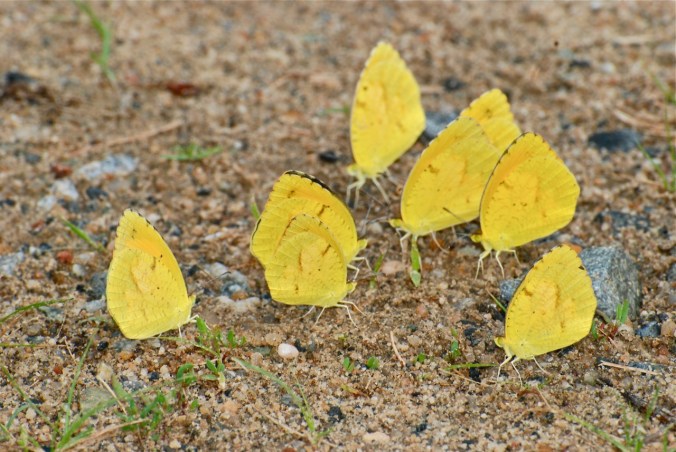
At any rate, I’m active in a butterfly group. We don’t collect them or otherwise harm them. We enjoy watching them, and some of us like photographing them. I also do programs on butterflies for nature societies, garden clubs, and other nature oriented groups.
Consequently, I hear a lot of questions, often the same ones repeatedly. I don’t claim to be an expert. Biology isn’t my academic discipline, but I’ve learned a thing or two about butterflies so I feel okay about answering the most common questions.
There are specialists who study butterflies scientifically (called lepidopterists). Then there are the rest of us who are curious about these insects but aren’t inclined to make a career in science to study them. Here are some interesting tidbits about butterflies for the rest of us:
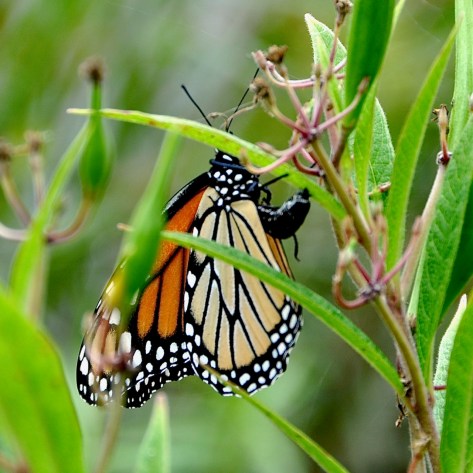
Butterflies and moths are closely related, and they share some physical features and behaviors in common. Like many other insects, both go through a series of bodily changes called metamorphosis. Let’s take a look at the process via the monarch butterfly.

The female lays eggs, which contain larvae (caterpillars) that emerge
when they’ve grown enough.
The caterpillar’s main job is to eat and grow.
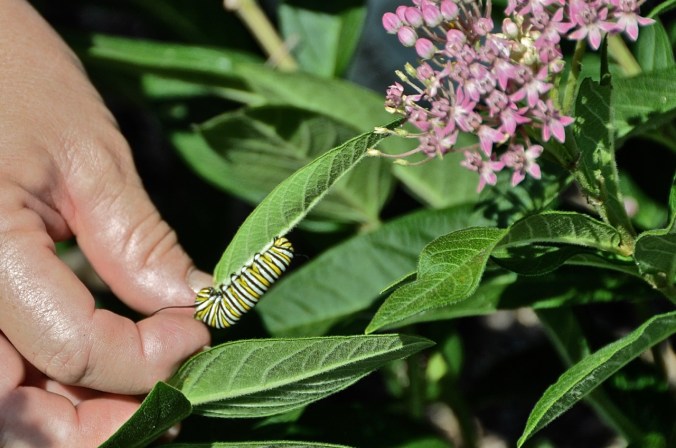
When they get as big as they’re going to get, they find a safe place to avoid predators where they go through another dramatic change by becoming
a pupa (cocoon for moths or chrysalis for butterflies).

The cells in the body go through yet another dramatic change by rearranging to become the creature with wings that emerges as an adult butterfly or moth,
in this case, a beautiful adult male monarch butterfly.

What’s the difference between butterflies and moths?
I’m going to use the phrase “tend to” a lot because when we talk about the differences, the majority of butterflies and moths may share common characteristics but almost always there are exceptions. For instance, butterflies usually fly during the daylight hours whereas moths mostly fly at night. However, there are exceptions.
Butterflies tend to be sleek whereas moths tend to be plump and fuzzy. Moth flight tends to be floppy and erratic, whereas butterfly flight tends to be direct and seemingly purposeful. Butterflies tend to be colorful and/or distinctly marked, while moths tend to be muted in shades of gray, tan, and brown.
Again, there are exceptions with some moths being large and dramatically marked. Both moths and butterflies have antennae, which are sensory organs, but moth antennae tend to have a feathery look while butterflies usually have slender wire-like antennae with a bump or “knob” at the tip.
In Part 2 I’ll answer more burning questions about butterflies. Do you have any such questions? Feel free to ask them in the comments.
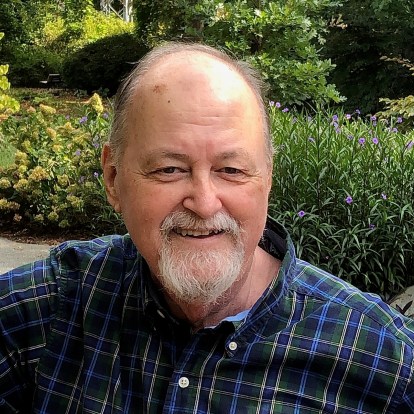 Dennis Burnette
Dennis Burnette is a retired college professor currently volunteering as a nature educator, focusing on birds, butterflies, and native plants. He does numerous presentations and field trips for nature organizations, master gardeners, garden clubs, church groups, scouts, etc. He is active in and has held elected office in several nature organizations. He has looked for native plants and other wildlife in 11 countries. Recently he received North Carolina’s Order of the Longleaf Pine in recognition of volunteer service to the state.
Some Additional Interesting Info About Dennis
*Past president of local Audubon Society chapter and currently on
the local Audubon board.
*Past board member of the statewide NC Native Plant Society.
*Past president of the Piedmont Bird Club.
*Past vice president of Carolina Bird Club.
*Founded the Carolina Butterfly Society in North and South Carolina
about 25 years ago; CBS now has about 200 members
in the Carolinas and surrounding states.
*Former member of the Guilford County Open Space Program Committee.
Dennis’s wife Lynn is a birder, butterflier and great travel companion.
 Dennis and Lynn Burnette


 The Write Stuff
Hi Dennis. You sound exactly like my older brother, Jim. He’s vice president of the North American Butterfly Association https://www.naba.org/ and an avid birder. Our dad worked for the Fish and Wildlife Service and was involved in the recovery of the black-footed ferret and the Aleutian Canada Goose.
LikeLiked by 3 people
Ah! Your brother’s another butterfly lover and birder, and your dad was involved in some pretty interesting wildlife and bird projects, too. Sounds like it runs in the family, and I’m glad you shared that with us. I’m thinking you’re going to enjoy Dennis’s wildlife posts over the weeks ahead, and I’m glad you stopped by today. Thanks for taking the time to comment, too! 😀
LikeLiked by 1 person
Hi, Pete. Thanks for the response. I know your brother’s name in his association with NABA. I believe that we have been in the same place at the same time at a butterfly event, although I don’t think that we have met formally. There certainly are some parallels! In my family, I’m the older brother who is interested in butterflies and butterfly conservation. My brother has been an avid outdoors man and sportsman all his life. My approach to nature is through photography and nature education.
LikeLiked by 2 people
I’ve been out butterflying with Jim. It’s fun for me to see him doing his thing—tracking butterflies with the goal of eventually photographing them. I used to go on bird counts with my dad as a boy. While I appreciate their love of nature, I don’t have anywhere their level of expertise.
LikeLiked by 1 person
Hi Marcia, it is lovely to meet Dennis and learn all this interesting information. Recently, I discovered that my spirit animal is a butterfly and I was a little taken aback. But seeing this description of flying flowers makes me feel much happier about being a butterfly.
LikeLiked by 3 people
Glad you enjoyed meeting Dennis and learned some new things from his post. (He knows his stuff!) I think having a butterfly for a spirit animal is pretty cool, and I’m glad you feel better about being a “flying flower.” Thanks for stopping by today. (Dennis will be along in a bit. It’s still pretty early here.) 😀
LikeLike
Thanks for your comments. I think it’s worth noting that imagining butterflies as “flying flowers” is a wonderful image, but as a spirit animal they also are strong and resilient. Butterflies are much more robust than we may be aware. For instance, consider the enormous strength and stamina it takes for Painted Lady butterflies in Eurasia and Monarch butterflies in North America to migrate hundreds of miles.
LikeLiked by 1 person
Fascinating creatures, butterflies…
LikeLiked by 2 people
I agree, Jaye & Anita, and I’m glad you enjoyed the post. Stay tuned for more on butterflies and other creatures in the weeks ahead. Hope you’ll love the series, and thanks for stopping by today! Have a great one! 😀
LikeLiked by 1 person
I will be back, Marcia… 🦋
LikeLiked by 1 person
Thanks for checking this entry out. Watch for Part 2 for more about this fascinating group of creatures.
LikeLiked by 2 people
Looking forward to that… 🦋
LikeLiked by 1 person
This is a terrific introduction to Dennis! I’d used cocoon and chrysalis interchangeably and there were many other things that this first piece clarified for me. I also loved the cartoon! Looking forward to the next one! 😀 ❤ 😀
LikeLiked by 2 people
So glad you enjoyed it, Trish, and that you learned a few new things already. Dennis is really knowledgeable about these things, and I’m pretty sure you’ll find his posts informative and interesting. Glad you enjoyed the cartoon, too.
Thanks so much for stopping by and taking time to comment. Dennis will be along soon, too. (I was up VERY early this morning, so beat him to the punch. 😀 ) Have a great day!
LikeLiked by 1 person
Enjoy your day, too! 😀 ❤
LikeLiked by 1 person
I appreciate your comment. I think many people use “cocoon” and “chrysalis” interchangeably. Even we butterfly fans would understand what someone means if they were to refer to a butterfly “cocoon.” When I see the word “cocoon,” I think of silk as in a silkworm moth cocoon wrapped in silk. Take another look at my photo of the Monarch butterfly chrysalis that accompanies this posting. It’s smooth, not wrapped in silk. It almost looks like a jade pendant to me. What a beautiful jewel-like structure, and no silk in sight!
LikeLiked by 2 people
I love that description and it’s so fitting. The silk worm is a great way to remember which is which. Thanks!
LikeLiked by 1 person
I love butterflies and I’ve learned some new facts today, so thanks for that, Dennis…and Marcia of course 🥰 Look forward to more.
LikeLiked by 1 person
Butterflies are a favorite of mine too, Cathy, though I don’t have anywhere near the accumulated knowledge and experience that Dennis has. I’m so glad you learned some new things today, and are looking forward to more. Part 2 on butterflies will be coming up next Wednesday, so hope to see you then.
Have a great day! 😀
LikeLiked by 1 person
Thanks, Marcia 🙂 You too!
LikeLiked by 1 person
It always thrills an educator to find that someone has learned something new today. Thanks for that comment! I do believe in trying to learn something new every day, or as I have seen it expressed elsewhere, “lifelong learning.” Even when I’m leading nature workshops, I find that I learn from the experiences talked about by the participants.
LikeLiked by 2 people
There’s always something new to learn, isn’t there 🙂
LikeLiked by 1 person
I knew the word “rabble,” but I didn’t know there were several more terms for a group of butterflies. Interesting post! There is a squashed turtle on our road (poor turtle). Swarms (or flights or wings) of rust-colored butterflies have been feeding on it. Do all butterflies feed on carrion as well as nectar?
LikeLiked by 1 person
Glad you enjoyed the post, Vera, and good question on the carrion. I’ve never seen that before, and have no idea if it’s common or not, but I’ll bet Dennis knows. Stay tuned, and we’ll see what he has to say.
Thanks so much for stopping by today, and I hope you’ll enjoy #WildlifeWednesday as we get it going. Have a great day! 😀
LikeLiked by 1 person
Great question! If I had the ability to post some additional photos along with this response, I would show you some photos I have shot of butterflies on carrion, animal droppings, and even on my wife’s sweaty sock during a hike. Adult butterflies are vegetarian by design in that their “tongue” is a drinking tube through which they sip flower nectar. However, flower nectar doesn’t contain all the nutrients some butterflies need. They will sip sap leaking from tree bark, juices from decomposing fruit, and other liquids such as found in animal scat, decomposing flesh, and even mineral-laden moisture from sand and mud.
LikeLiked by 2 people
We can do a bonus post with any photos you’d like to add in reference to specific questions, Dennis. That would be fun. 😀
LikeLike
Wow, how interesting! Thanks, Dennis!
LikeLike
I’ve been researching moths lately for an upcoming story. There’s some interesting stuff about them, but not as much mythology or mysticism as I expected. I’m going to have to make some of it up myself, but I have a decent basis for it. I enjoyed your post, Dennis.
LikeLiked by 1 person
I think with your usual genre, you have lots of latitude for making up a few things, Craig, especially with a “decent basis.” Glad you enjoyed Dennis’s post, and stay tuned for Part 2 next Wednesday. Who knows? You might pick up some other goodies you can use in your story. 😀
Thanks for stopping by this morning, and for taking a few minutes to comment. Hope you have a super day! 😀
LikeLiked by 1 person
I can’t add much to what you probably already know about moth mythology or mysticism. My minor contribution is to suggest that you look up the Black Witch Moth, Ascalapha odorata. If I had the ability to post a photo here with this response, I would show you one that I photographed in The Bahamas. It was a large, dark-brown, almost black, creature that came in though an open window. There is rich lore about this very large, very dark, very silent creature swooping in like a bat, which it resembles, to take people’s souls. That’s the only one I have ever seen. I thought that it was linked to the West Indies, but I just saw a posting by a friend whose wife spotted one near Charleston, South Carolina. (She didn’t get a photo, unfortunately.) I think it’s probable that there is a good bit of mythology about this moth in South Carolina Gullah culture, as well.
LikeLiked by 2 people
Okay, that makes #2 we can share in a bonus post, if you like, Dennis. I’ve never been able to get photos to work in the comments section, but I think a Bonus post would give us a chance to share them just fine, plus anything else that you think of you’d like to toss into the mix. 🙂
LikeLike
I am aware of that one and the white witch. Im going to use some of that in conjunction with the ones that suck blood. There is a Canadensis version of that one. After that, I have to use my imagination.
LikeLiked by 1 person
Great post, Dennis. Very interesting information. I’m another who likes to (or at least tries to, they keep moving so much) photograph butterflies. I look forward to your next post .
LikeLiked by 1 person
So glad you enjoyed Dennis’s post today, Jeanne. And how cool that you like to photograph butterflies, though I’m sure it must be tricky. I can hardly follow one with my eyes when they fly through the garden, up and down, this way and that. It must be pretty tricky to capture the image you want.
Thanks for stopping by this morning and taking a moment to say hello. Be sure to check out Butterflies Part 2 next Wednesday for even more good information. Have a great day! 😀
LikeLiked by 1 person
Thanks for your comment and response about butterfly photography! I think that you’re probably aware that all the photos that accompany this Wildlife Wednesday entry are ones I shot. I’m going to be bold and give you a tip on photographing butterflies. If you take a close look at a butterfly’s eyes, you’ll notice that they are large, oval, and cover most of each side of the head. Their field of view must be enormous compared to ours. In most butterfly species, the eyes don’t actually touch behind the head. I suspect that this is a blind spot. Butterflies can’t hear but they’re very sensitive to motion. Find a butterfly that’s occupied sipping nectar. If you come up behind the butterfly and approach slowly, you often can get quite close. If the butterfly turns, as they often do, stay still for a few moments, then advance slowly and try to get behind it again. I shoot a picture with each step closer so that I have some images even if they aren’t as close as I had hoped.
LikeLiked by 2 people
Thanks for the tip
LikeLiked by 1 person
My knowledge of butterflies and moths has increased hundred fold thanks to your information, Dennis. I’m abhorred that some people collect these magnificent “flying flowers.” Taking pictures-as you do-is a better way to share their beauty and document butterflies that are encountered. Thanks, Marcia, for introducing us to Dennis!
LikeLiked by 1 person
I’m glad you enjoyed (and learned a lot) from Dennis’s post today, Nancy! He’ll be along soon to respond to comments, I’m sure, and you’ll find he’s a pretty nice guy, in addition to being well informed on LOTS of critters and habitats!
Thanks so much for stopping by today and taking as moment to say hi! Have a great one! 😀
LikeLiked by 1 person
What a very nice thing to say! As an educator, I love hearing that my presentations, and this posting in particular, gave you more knowledge on a topic you clearly love. I have never collected butterflies, although I don’t mean that as a criticism of the thousands of kids who had their introduction to butterflies and other insects through their collections. I do like big butterfly displays, so my approach at home was to have 20 or so of our most beautiful and interesting species printed and framed, and then I mounted the photos on our foyer wall.
LikeLiked by 2 people
Love this, Dennis! Butterflies are such fascinating creatures. Thank you for sharing your knowledge. Looking forward to Part II.
Hey, Marcia! 😀
LikeLiked by 1 person
Hey, Sue! 😀 Glad you enjoyed Dennis’s post, and I agree that butterflies are fascinating! Part 2 has even more goodies included, so I’m glad you’re planning to check it out. Thanks for stopping by today, and here’s to a great afternoon! 😀
LikeLiked by 1 person
Thanks! I’m happy to share my knowledge and looking forward to other folks sharing their experience and knowledge.
LikeLiked by 1 person
This was very interesting. I love the term kaleidoscope for a group of butterflies, it’s perfect.
LikeLiked by 1 person
Glad you enjoyed it, Jennie, and I agree that a kaleidoscope of butterflies seems to fit pretty well. Thanks so much for visiting today, and for taking a moment to share your thoughts. Have a great afternoon! 😀
LikeLiked by 1 person
You are welcome. Did you know the Pennsylvania Dutch called butterflies ‘flutter-bys’. Makes more sense, doesn’t it? Best to you, Marcia. 🙂
LikeLiked by 1 person
I’ve heard that and even used it a couple of times, myself, Jennie. And yep. It makes more sense than “butter” flies, doesn’t it? 😀
LikeLiked by 1 person
Yes!
LikeLiked by 1 person
I agree. I think a “kaleidoscope” of butterflies paints a great mental image. I also visualize a beautiful stained glass panel of our most beautiful butterflies on native wildflowers. Thanks for sharing your comments.
LikeLiked by 2 people
You are exactly right, and your visual image of stained glass is just perfect. Best to you, Dennis.
LikeLiked by 1 person
A fascinating post, Dennis. I love butterflies, and it was terrific to read more about them. Looking forward to Part 2. Thanks, Marcia.
LikeLiked by 1 person
So glad you enjoyed Dennis’s post, John, and I think you’ll enjoy Part 2 even more. Butterflies are rather remarkable, aren’t they? Thanks so much for stopping by today and taking a moment to share your thoughts. Have a super afternoon! 😀
LikeLiked by 1 person
😁
LikeLiked by 1 person
Thanks for the nice comment! I think you’ll like Part 2.
LikeLiked by 2 people
I’m sure I will.
LikeLike
Great post and information, Dennis:) I’m a huge fan of butterflies… and moths too. I am always trying to get that perfect shot of them.
LikeLiked by 1 person
So glad you enjoyed Dennis’s post, Denise, and I think you’ll like Part 2 even more. It’s filled with more goodies and pics.
Thanks so much for stopping by today and sharing your thoughts. Good luck with your photograph, too. 😀
LikeLiked by 1 person
Thanks! My first response yesterday apparently didn’t “take.” It’s good to hear from another huge fan of butterflies and moths. I would like to hear about some of your perfect shot adventures. I’m always seeking the perfect shot, too.
LikeLiked by 1 person
Still seeking that shot but having fun following them around!
LikeLiked by 1 person
Following them around can be as much fun as photographing them. It’s the quest that’s fun. Also, my definition of “the perfect shot” depends on how I think I might use the photo. I once shot a photo of a dog sitting in the driver’s seat of a small, bright red pick-up truck parked in front of a grocery store. Over time as I have come across that photo again and again, I always am amused by it. I actually used it in a talk that I did to illustrate the idea of picking the right field trip leader for an outing.
LikeLiked by 2 people
That sounds like a fun shot and one I’d consider sucessful, especially if it brings a smile.
LikeLiked by 1 person
Going forward, I will always and forever think of butterflies as flying flowers! Great post!
LikeLiked by 1 person
It’s a perfect description, isn’t it, Jan? So glad you enjoyed Dennis’s post, and I’m pretty sure you’ll like Part 2, as well. Thanks for joining us today, and hope you have a great afternoon! 😀
LikeLike
I tried responding to you yesterday but something went awry, at least on my end. You may have seen this already: The phrase “flying flowers” paints a word picture for me. If you’ve ever walked through a meadow of blooming wildflowers in the warm summer sun, butterflies rising on the breeze, you know what I mean.
LikeLike
This was thoroughly intriguing from start to finish. I’ve never heard the term “flying flowers” but I’m going to latch onto it! I also love “puddle parties,” and I can thoroughly see where a group of butterflies would be called a kaleidoscope.
I was once able to witness a kaleidoscope in nature. It was at Little Round Top (at the National Civil War Park in Gettysburg). When hubby and I reached the top there were dozens of Monarch butterflies flitting around the monuments. I have no idea what attracted them, but it was amazing, and a sight, I’ll never forget.
Thank you for the wonderfully educational post, Dennis, and thanks, Marcia, for introducing your friend to us!
LikeLiked by 1 person
It was my very great pleasure to have Dennis visit here today, Mae, and I’m so glad you enjoyed his post. With any luck, we can talk him into stopping by now and then with more wildlife & habitat posts. I think we’d all enjoy that, right? (Maybe he might even have an idea as to why those monarchs were visiting Gettysburg.)
Thanks for stopping by today and sharing your thoughts, my friend, and stay tuned for Butterflies Part 2 next Wednesday! 😀
LikeLiked by 1 person
I’m going to miss part-two. I’ll be on a mini vacation out of town, but I’ll watch for future posts!
LikeLiked by 1 person
Not a problem, Mae. You can still read the post after your return, just to see what was shared. It will be available for … well … forever! 😂😂😂
LikeLiked by 1 person
😂
LikeLiked by 1 person
I apologize for the delay. I attempted to send this yesterday but had technical difficulty. I appreciate your comments so much! You’ve helped introduce us to another interesting part of butterfly lore, and I thank you for sharing your observation. Dozens of Monarch butterflies flitting around Little Round Top battlefield is a behavior appropriately called “hill-topping.” Male butterflies congregate on or near the highest point in the vicinity to watch for potential mates. (Other insect species do this, too.) That’s the biological explanation. The anthropology of this is that a group of butterflies on the highest point in a battlefield could be construed by a family member to be the souls of the fallen soldiers.
LikeLiked by 1 person
I never heard of this, Dennis, and find it very interesting. (Both perspectives.) Thanks so much for sharing! 😀
LikeLiked by 1 person
Hi, Dennis. Thank you for that explanation. It’s utterly fascinating! All those butterflies in one place felt like a magical experience–especially given the location. The biological explanation makes sense, but I love the idea of the folklore-ish one, too. Thanks for the fabulous information on hill-topping!
LikeLiked by 1 person
Part 2 will be here for you to read when you get back.
LikeLiked by 2 people
I’ve always been mesmerized by butterflies, so I’m ecstatic to see a post about them. Thank you for sharing with us, Dennis! And thank you, Marcia, for bringing him to your site.
LikeLiked by 1 person
Thanks for your comment! The first time I remember noticing a butterfly was when one flew by across my field of view while I was watching a bird with my binoculars. I followed it’s flight until it was out of sight. I didn’t know the species (it was an Eastern Tiger Swallowtail, I determined later) but I decided to look it up in a field guide the next time I was in a bookstore. That was more than 25 years ago. I still watch birds, but my world has been expanded. It now includes butterflies and the native plant species they like.
LikeLiked by 2 people
That’s so neat! While I’ve always loved butterflies, I’ve only recently became obsessed with birds. I’m not great with determining species, although I try. There’s not much better than getting lost in observing nature. ❤
LikeLiked by 1 person
I suppose I’m obsessed with all of nature, even critters some people don’t like such as snakes. As for determining the species, I’m sure that you’re aware that we do that for ourselves, not for the creatures that we’re watching. The butterfly (or bird, or snake) doesn’t care what we call it. Here’s a tip that has helped me: carry along a small pad and a pencil. When you see something you can’t identify, describe it on your pad. Be as detailed as you can with overall impression, primary color(s), any spots or bands that catch your eye, that sort of thing. I have even sketched birds I don’t know. Then say to yourself, I don’t know what others call this, but I think the name should be___. It doesn’t always work, but it helps identify things sometimes. I once saw a wildflower blooming at the edge of pine woods. It had pale blue flowers that were star-shaped with five pointed petals. I thought, “I don’t know what that is but I would call it “blue-star.” I photographed it and then looked it up when I got to a friend’s house where there was a field guide. There are three wildflowers called “blue star,” and my photo helped me narrow it down to the most common one where I was visiting.
LikeLiked by 2 people
That’s a wonderful idea, Dennis! I’ll have to do that! Carrying a notebook with me is such a natural thing already!
LikeLiked by 1 person
It was my great pleasure to have Dennis share his expert knowledge with us today, and I’m glad to know you enjoyed his post. Be sure to check back in next Wednesday for Part 2 of Butteflies for the Rest of Us. And thanks so much for stopping by to day, too! 😀 ❤
LikeLiked by 1 person
This ROCKED. I LOVE butterflies. I don’t know all that much about them, but they’re great 🙂 I appreciate learning more. I DO have a question. What do you (and Dennis) think about Butterfly Conservatories? I’ve been to this place and it was magical: https://www.missouribotanicalgarden.org/plan-your-visit/family-of-attractions/butterfly-house.
LikeLiked by 1 person
Glad you enjoyed the post, Sue, and thanks for letting us know. Dennis might be a bit late in answering your question, as his schedule is pretty tight. As for myself, I’ve only been to one butterfly conservatory, and it was part of the University of Florida in Gainesville, and I loved it! It was beautifully planted with all sorts of butterflies that seemed to be quite happy to be there. I am NOT an expert on them, though, so Dennis may have a different opinion. I just remember taking my mother there some years ago, and she (and my kids) were amazed and delighted. I’ll check out your link tomorrow, but I’m sure it will be as magical as you say.
Thanks for stopping by and taking a moment to say hello. Have a great rest of the week! 😀 ❤
LikeLiked by 1 person
It was amazing. I was there twice and loved it both times. I wish they had something like that closer to where I live now.
LikeLiked by 1 person
I apologize for my delay in responding. I try to put out some kind of meaningful response within 24 hours, but life sometimes gets in the way. I participated in a Pollinator Day event on Saturday and a meeting about native plants in the city just west of where I live on Sunday afternoon, then spent Monday trying to catch up on emails and other tasks. I didn’t quite make my self-imposed deadline this time.
Butterfly conservatories can provide wonderful experiences, especially if the visitors are immersed among the flowering plants with butterflies on the wing all around. (I haven’t been to the Missouri Botanical Garden but hope to go someday.) I have been to several butterfly enclosures, some small and a few quite large. They’re basically butterfly zoos, and they provide the same kind of educational opportunities that zoos with large animals provide. All except one that I have visited had colorful tropical butterflies on display. The exception was a small enclosure at a nature center in Danville, Virginia that had native North American butterflies.
While butterfly conservatories can be great fun as well as being educational, my favorite way to view butterflies is finding wild, free-flying native butterflies in nature. I can’t think of anything much better than watching a Monarch butterfly laying her eggs on native milkweed! I also enjoy visiting public gardens to find butterflies. You don’t have to know their names in order to enjoy butterflies, but there are several good field guides to native butterflies available if you want to learn to identify them.
LikeLike
Hi Dennis! No worries about the “late post” which was FAR from late! Sometimes, my comments come about a week or two after the initial entry! I really appreciate the butterfly information. We let milkweeds grow wherever they want in our front and back yard. The fuzzy bees like them, too. Yes, if you get the chance, the conservatory near St. Louis is really something. At least it was for me – as it was the first “butterfly zoo” I’d ever seen.
LikeLiked by 1 person
In the majority of butterfly conservatories I have visited, the butterfly species have been from the “New World” tropics. As an example, the iridescent blue butterfly pictured on the Missouri Botanical Garden website appears to be a blue morpho. I have wondered where their “livestock” came from.
I found at least one of the sources of butterflies several years ago before I retired. I took a group of students to Costa Rica (where we saw wild and free-flying blue morphos) for a cultural studies study-abroad trip. One of the businesses we visited was a butterfly “ranch” where multiple species were being raised.
Their technique was to capture native species in the jungle and bring them back to the enclosure, which contained the caterpillar food plants (host plants) for those specific butterfly species. The captive butterflies were not sold. They were kept as breeding stock. They would mate and lay eggs on the caterpillar host plants, feed the caterpillars, which would grow to full size and then form chrysalises. These were collected by employees, packaged safely in shipping containers, and sold to conservatories, zoos and other butterfly enclosures all over the world.
In other words, they were attempting (and succeeding, I think) to have a sustainable way for the Missouri Botanical Garden and other venues to be able to have their educational butterfly displays without taking the succeeding generations of butterflies from the wild.
LikeLiked by 2 people
I’m glad that they were doing it safely and responsibly. That’s the best way!
LikeLiked by 1 person
Nicely written with beautiful photos
LikeLiked by 1 person