#WildlifeWednesday – #NotesFromTheSt.JohnsRiver – #LittleBlueHerons

Back in December of 2016, I was asked by my friend and mentor, the late Doug Little, if I’d like to be part of a brand new blog on his St. Johns River Eco Tours website. I thought it sounded like a lot of fun, and was honored to be invited to create some nature-related posts for him, in a series called Notes From the River

Now that my Bird Nerd friend, Dennis Burnette, has joined me here at The Write Stuff with his own nature-related posts, I thought it would also be fun to share some of the ones I did for Doug’s blog now and then, too. I’m starting this off with one I hope you’ll all enjoy.


#NotesFromTheRiver:
When Is a Little Blue Heron NOT a Little Blue Heron?
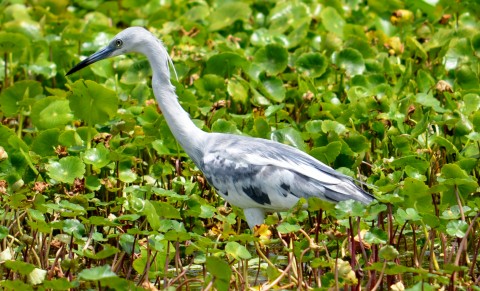
When It’s a Calico Heron, That’s When!

 Today, I’m going to share some lesser known information about the Little Blue Heron, and yep, that’s one above, even though most photos show little blues looking like this:
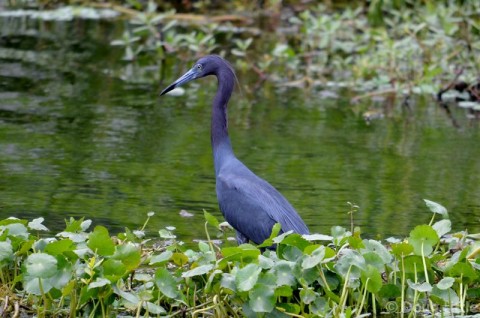
Adult Little Blue Heron

The truth is that even though little blue herons end up a solid, slate blue, with a purplish cast to the neck, just like the picture above, they ALL start out white. See? The bird in this next photo is also a little blue heron, but in juvenile plumage.

Immature Little Blue Heron

When little blue herons fledge (leave the nest), they are solid white birds, which means they are often misidentified as snowy egrets or cattle egrets. Only their smaller size keeps them from being pointed out as great egrets, as well. But if you look closely, you see immature little blue herons have greenish yellow legs, and blue-grey beaks with a dark tip. Snowy egrets have black legs with golden yellow feet and black beaks, and cattle egrets, which are usually seen in fields and pastures rather than wading along the water’s edge, have bright yellow legs and beaks.

As you might imagine, if the bird starts off white, and ends up dark blue-grey, there must be an intermediate stage to get from this:

Juvenile Little Blue Heron

To this:

Adult Little Blue Heron

Et voila! Here’s the aforementioned intermediate stage!

A Juvenile Little Blue Heron Molting
into Adult Plumage
(Again, this is the stage when they are often called calico herons.)


Little Blue Heron Range Map


As you can see, the little blue heron is a wide-spread bird, and breeds throughout large portions of the southeastern United States. They are very common birds, with no current population issues, which means birders have a good chance of spotting them any time they are on or near freshwater ponds, lakes, marshes, swamps, and rivers.
They are sometimes found on marine coastlines, as well.

So, if you want to add this bird to your life list, you probably won’t have to go to any great lengths to find adult specimens. And the white juvenile birds are often easy to spot, as well. But if you’re hoping to photograph them in the calico stage, you might have to hunt a little longer, and at the right time of year. It’s an in-between stage, after all, and doesn’t last forever. As you can see in the next photo, the blue gray adult plumage on this bird is definitely taking over from the white. Won’t be long before it looks just like mom and dad.

A collective of herons is known as a battery, a hedge, a pose, a rookery, and a scattering. Take your pick.
I’m hedging my bets with “hedge.”


Little blue herons are medium sized waders, standing about 2 feet tall, with a wingspan of around 40 inches.They eat a variety of fish, insects, and various other invertebrates, including crayfish, like the one  below.

Hapless “Mudbug” About To Go to Crawdad Heaven.

These birds are colony nesters, quite happy to join other egrets and herons, including cattle egrets, which is interesting, because those are not even native to North America. Little blues lay as many as six pale, blue green eggs at a time, which they incubate for 22 to 24 days, before the eggs hatch into some rather scruffy chicks, sporting some seriously punkish spiked “hair.”

From this . . .

To this . . .


. . . then this . . .

and finally, THIS!

Adult Little Blue Heron

And there you have it, folks. Hope you enjoyed learning a bit more about this common, but very beautiful, heron. Keep your eyes open when out on the rivers and lakes, and maybe you’ll spot that equally beautiful, in-between stage, known as the calico heron.


NOTE: This post with Doug’s photos first appeared on the
St. Johns River Eco Tours blog here:
When Is a Little Blue Heron Not a Little Blue Heron?

#WildlifeWednesday – #ButterfliesForTheRestOfUsPart2 – Featuring #DennisBurnette

It’s #Wildlife Wednesday again, folks, and I’m happy to say that my friend Dennis Burnette is back to visit us with Part 2 of his very informative Butterflies for the Rest of Us post. I know you’ll enjoy learning more about these interesting insects and seeing lots of fabulous photos. And now, without further ado, I’m turning the floor over to Dennis!  Take it away, my friend!


Thanks, Marcia!


Butterflies for the Rest of Us Part 2


PLEASE NOTE:
All photographs in this post were taken by and belong to
Dennis Burnette. Thank you for respecting that.


In Part 1 I explained that I’m active in a butterfly group. We’re similar to a bird-watching group in that we enjoy watching and identifying them but not harming them. As a retired educator, I enjoy presenting programs on butterflies for nature-oriented groups.

As I said in the last installment, I get a lot of questions. Biology isn’t my academic discipline, but in the 25 years or so that I have been watching and studying butterflies, I’ve learned some interesting facts about them.

Probably this is the most common question I hear: What’s the difference between butterflies and moths? I gave some answers to that one last time. Here are some additional questions people ask:

How old can butterflies get?

The process of metamorphosis usually takes several weeks, the exact time depending on the species of butterfly and external factors such as weather. Once metamorphosis is complete, the adult emerges and seeks out mates. Keep in mind that it’s still a butterfly whether it’s an egg, a caterpillar, a chrysalis, or an adult, so the butterflies we see flying are in their fourth stage of life. They’re elderly bugs! Some butterflies live for a few weeks as an adult. Others may live more than a year. Generally speaking, most butterflies tend to live a few months from egg through adulthood. Butterfly species that migrate tend to live longer than those that don’t. Storms, attempted predation, strong winds, and obstacles encountered in flight eventually wear out an old butterfly’s wings.

A very old and battered Common Buckeye butterfly.

Can a butterfly sting or bite you?

Butterflies do not have stingers at any stage of metamorphosis. When a butterfly is a caterpillar, its mouthparts are designed to chew leaves. It doesn’t have teeth, pincers or any other structure that would allow it to bite a person. In the chrysalis stage the cells are rearranged so that the mouth becomes a tube (proboscis) similar to a drinking straw to allow it to drink nectar from flowers. When it isn’t using the tube, it keeps it curled up under its head. There is nothing about the drinking tube that could hurt a person.

Butterflies spend part of their lives as caterpillars, but not all caterpillars are butterfly larvae. In addition to moths, other organisms such as beetles and flies may spend time as caterpillars or caterpillar-like forms. A few of these have stinging hair-like structures on their bodies. It you find a critter that looks like a hairy or fuzzy caterpillar, it’s best not to touch it to avoid getting stung unless you know for sure what it is.

What do butterflies do during cold or rainy weather?

Most butterfly species prefer warm temperatures and sunny skies. When the weather turns cooler than they’re used to, they have trouble making their muscles work. They’ll find a crevice in tree bark or rocks, a brush pile, or other protected place to hide until the temperatures get warmer. Likewise, if it’s raining, even in warm weather, often they will find a place to hide. It isn’t uncommon to find butterflies hanging upside down under a large leaf during and just after rainstorms.

Cabbage White butterfly sheltering under a leaf.

Should I set up a butterfly house to help butterflies in my neighborhood?

People see boxes somewhat like bird nesting boxes for sale in some gift shops and garden centers that are labeled “butterfly house.” Often they’re brightly painted with images of butterflies and flowers. These may look attractive in a garden as garden art. However, they aren’t likely to attract butterflies. They rarely (or never?) are used by butterflies, although theoretically they could use them to get in out of the rain. I’ve never heard of that happening, however.

Butterfly houses aren’t likely to attract butterflies but
could make pretty garden ornaments.

Where do butterflies go in winter?

The flight period for most butterfly species is during some part of the warmer months. The life expectancy for most species of North American butterflies is measured in weeks and months. Most are no longer flying in winter in all but the warmest parts of this continent. That being said, some butterflies migrate. You may already know about Monarch butterflies and their long migration of almost 3,000 miles between central Mexico to southern Canada, and there are other migratory butterfly species, as well. Also, there are a few butterflies that are hardier in cold weather than most so they have a longer flight period, and a few species that stay put but hibernate. If they stay put, a few spend the winter as adults, but most spend the winter hidden from predators as chrysalises.

Sanctuary for migrating Monarch butterflies in Mexico.
(NOTE: For those who may not realize this, every one of those little orange “leaves” in this picture is actually a monarch butterfly. )

Butterflies may be pretty, but what good are they?

We often hear the term “ecosystem.” Butterflies are part of it. If you’ve ever seen a house being built, you already understand the concept of a system of components. Beginning with the foundation, different pieces are connected to form the flooring and “bones” of the house, each piece different in form, function, and materials but becoming interconnected. An ecosystem is made up of the living and nonliving elements of the environment, the living organisms, soil, water, and weather, within a particular geographical area.

Butterflies are pollinators. While they aren’t quite as efficient as honeybees, they are important pollinators for many plant species. For instance, some early native azaleas are pollinated almost exclusively by a species of swallowtail butterfly. Butterflies also are a food source for other organisms such as birds as part of the food chain. Further, for humans concerned about the environment, butterflies are an indicator species. A healthy butterfly population signals a healthy ecosystem.

Black form Eastern Tiger Swallowtail carrying
pollen on its body.

Do you have other questions about butterflies? Feel free to ask them in the comments.


NOTE: Due to a very busy schedule, Dennis may not always be able
to respond to comments  immediately, but he will do his best to get back
to you within a day. Thanks for your understanding!


Dennis Burnette
Birding on Great Abaco Island in the Bahamas

Dennis Burnette is a retired college professor currently volunteering as a nature educator, focusing on birds, butterflies, and native plants. He does numerous presentations and field trips for nature organizations, master gardeners, garden clubs, church groups, scouts, etc. He is active in and has held elected office in several nature organizations. He has looked for native plants and other wildlife in 11 countries. Recently he received North Carolina’s Order of the Longleaf Pine in recognition of volunteer service to the state.


Some Additional Interesting  Info About Dennis

*Past president of local Audubon Society chapter and currently on
the local Audubon board.

*Past board member of the statewide NC Native Plant Society.

*Past president of the Piedmont Bird Club.

*Past vice president of Carolina Bird Club.

*Founded the Carolina Butterfly Society in North and South Carolina
about 25 years ago; CBS now has about 200 members
in the Carolinas and surrounding states.

*Former member of the Guilford County Open Space Program Committee.


Enjoying a cruise on the Cape Fear River

in Wilmington, North Carolina


Hope you’ve enjoyed learning a bit more
about butterflies today. Stay tuned for additional info
on future visits from Dennis, featuring wildlife of all sorts!

#WildlifeWednesday – #ButterfliesForTheRestOfUs – Featuring #DennisBurnette

Today, it’s my great pleasure to introduce my very good friend and wildlife lover, Dennis Burnette. Some of you may remember I mentioned having reconnected with Dennis recently, after more than 60 years. (We were friends in high school, waaay back then). In addition to just the pleasure of hearing from him, it was great fun to find out he loves wildlife as much as I do, and has spent many years photographing and documenting all sorts of things about the birds and other creatures we share the world with. Naturally, I immediately asked Dennis to share some of his knowledge with us here on The Write Stuff, and he agreed. I know you guys will make him feel welcome, and will enjoy his visits, so let’s get started! Dennis, the floor is yours. Take it away, my friend!


NOTE: Somehow, I managed to forget to give Dennis credit for all photos in this post! I had a little blurb written up to go with that info, too, but I can’t find it now. So, for any of you who are wondering, all of today’s photos were taken by, and belong to, Dennis Burnette. Thanks for respecting that! 😀


Marcia asked me to write a few words about my experiences with wildlife. I’m honored; thanks, Marcia. I’ll try to do you proud.

Butterflies for the Rest of Us Part 1

I titled this first entry “Butterflies for the Rest of Us” because there are artistic and creative people who love the colors and patterns of what some folks call “flying flowers,” and there are people who make a career of serious scientific studies of butterflies. I know from experience that there are many of us who enjoy learning about wildlife as part of our overall love of nature. I think of these folks as “the rest of us.”

It’s odd how the mind works. I just wrote the sentence, “I’m active in a butterfly group.” That raised an image in my mind of me standing around at a cocktail party interacting with a bunch of butterflies. That led to me wondering if an actual group of butterflies (as opposed to a fantasy group at a cocktail party) is called anything in particular, like a flock or even a herd.

That led me to the Internet where I found an answer to that question. It may be AN answer, but I’m not convinced that it is THE answer. On a website I’ve never visited before called BeingHuman.org I found the following: “A group of butterflies is a kaleidoscope. They’re also known as a swarm, flutter, flight, rabble, or a wing of butterflies.”

I have been interested in butterflies as an amateur naturalist for at least 25 years.  (I’ve never collected butterflies, although I love to photograph them.) In all that time I have heard only one collective term for a bunch of butterflies, and it wasn’t kaleidoscope or any other term on the above list.

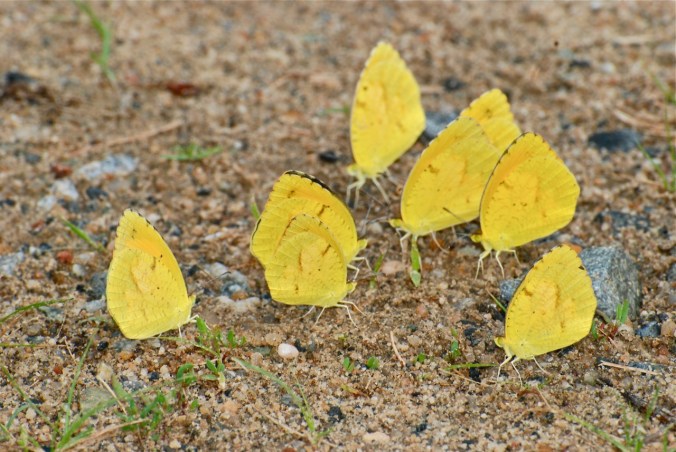
That’s because butterflies generally don’t form up into groups like a flock of birds or a herd of bison. Sometimes butterflies will be drawn to a patch of damp soil such as on a dirt road. Experts on butterfly behavior say that they are seeking minerals that they can’t get in flower nectar.

Often it’s just one butterfly, but occasionally other butterflies find the same damp spot. I have seen more than a dozen individuals of different species congregating on the same patch of damp soil. Butterfly watchers call these conglomerations “puddle parties.” A butterfly engaged in that behavior is said to be “puddling.”

At any rate, I’m active in a butterfly group. We don’t collect them or otherwise harm them. We enjoy watching them, and some of us like photographing them. I also do programs on butterflies for nature societies, garden clubs, and other nature oriented groups.

Consequently, I hear a lot of questions, often the same ones repeatedly. I don’t claim to be an expert. Biology isn’t my academic discipline, but I’ve learned a thing or two about butterflies so I feel okay about answering the most common questions.

There are specialists who study butterflies scientifically (called lepidopterists). Then there are the rest of us who are curious about these insects but aren’t inclined to make a career in science to study them. Here are some interesting tidbits about butterflies for the rest of us:

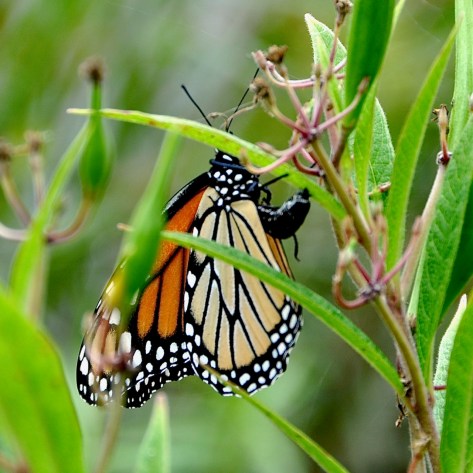
Butterflies and moths are closely related, and they share some physical features and behaviors in common. Like many other insects, both go through a series of bodily changes called metamorphosis. Let’s take a look at the process via the monarch butterfly.

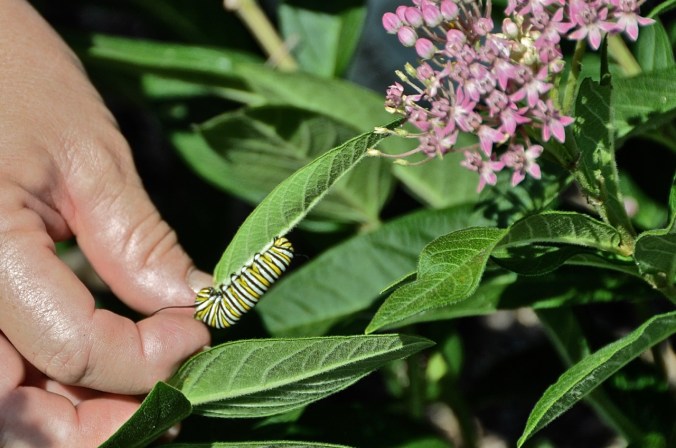
The female lays eggs, which contain larvae (caterpillars) that emerge
when they’ve grown enough.

The caterpillar’s main job is to eat and grow.

When they get as big as they’re going to get, they find a safe place to avoid predators where they go through another dramatic change by becoming
a pupa (cocoon for moths or chrysalis for butterflies).

The cells in the body go through yet another dramatic change by rearranging to become the creature with wings that emerges as an adult butterfly or moth,
in this case, a beautiful adult male monarch butterfly.

What’s the difference between butterflies and moths?

I’m going to use the phrase “tend to” a lot because when we talk about the differences, the majority of butterflies and moths may share common characteristics but almost always there are exceptions. For instance, butterflies usually fly during the daylight hours whereas moths mostly fly at night. However, there are exceptions.

Butterflies tend to be sleek whereas moths tend to be plump and fuzzy. Moth flight tends to be floppy and erratic, whereas butterfly flight tends to be direct and seemingly purposeful. Butterflies tend to be colorful and/or distinctly marked, while moths tend to be muted in shades of gray, tan, and brown.

Again, there are exceptions with some moths being large and dramatically marked. Both moths and butterflies have antennae, which are sensory organs, but moth antennae tend to have a feathery look while butterflies usually have slender wire-like antennae with a bump or “knob” at the tip.

In Part 2 I’ll answer more burning questions about butterflies. Do you have any such questions? Feel free to ask them in the comments.


Dennis Burnette

Dennis Burnette is a retired college professor currently volunteering as a nature educator, focusing on birds, butterflies, and native plants. He does numerous presentations and field trips for nature organizations, master gardeners, garden clubs, church groups, scouts, etc. He is active in and has held elected office in several nature organizations. He has looked for native plants and other wildlife in 11 countries. Recently he received North Carolina’s Order of the Longleaf Pine in recognition of volunteer service to the state.


Some Additional Interesting  Info About Dennis

*Past president of local Audubon Society chapter and currently on
the local Audubon board.

*Past board member of the statewide NC Native Plant Society.

*Past president of the Piedmont Bird Club.

*Past vice president of Carolina Bird Club.

*Founded the Carolina Butterfly Society in North and South Carolina
about 25 years ago; CBS now has about 200 members
in the Carolinas and surrounding states.

*Former member of the Guilford County Open Space Program Committee.


Dennis’s wife Lynn is a birder, butterflier and great travel companion.

Dennis and Lynn Burnette


HOPE YOU’VE ENJOYED THIS INTRO TO BUTTERFLIES. 
BE SURE TO STOP BY ON JUNE 28 WHEN
DENNIS WILL BE BACK WITH 
LOTS MORE GOOD STUFF!
SEE YOU THEN!

#BonusWildlifePost – #Crocodile vs #Alligator

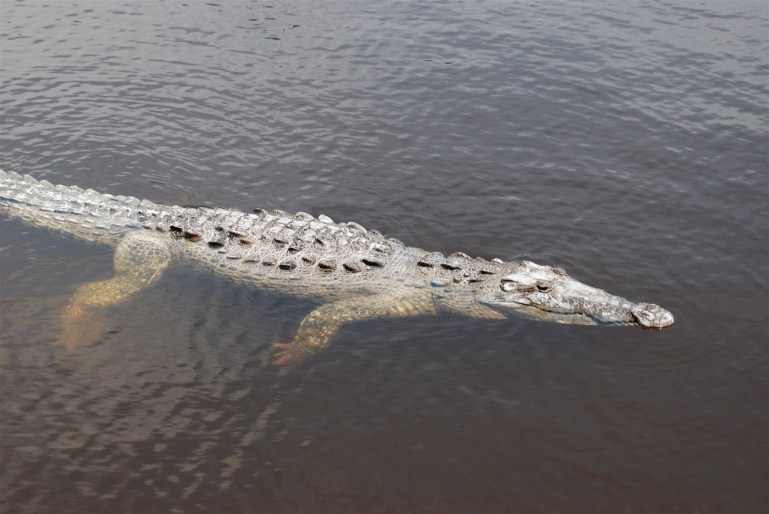
Just wanted to show you folks a couple of photos my friend, Dennis, shared with me yesterday. I’ve mentioned that he’s a terrific photographer, and I wasn’t kidding. He’s been taking pictures of wildlife ( and much more) for many years. After reading my post on Alligators yesterday, he sent me two shots of the American saltwater crocodile that he took down in south Florida, and I think they are two of the best pics of them I’ve ever seen–so my first thought was to do a bonus post so I could share them with you.

You can VERY clearly see the lighter color of this crocodile, and the extremely pointed “V” that makes up his head. I also found a comparison photo of a swimming alligator that shows once again that 1) it is very nearly black in color and 2) the head is definitely not pointy at all.

American Saltwater Crocodile
(Photo by Dennis Burnette)

American Alligator for Comparison
(Photo from Pexels)

Head Shot of American Salt Water Crocodile
(Photo by Dennis Burnette)

Hope you enjoyed the comparison and that it will help you remember that alligators and crocodiles are not the same critters! 


Next time, we’ll be back to alligators with …
“Bringing Up Baby!”
See you then!

#WildlifeWednesday – #AmericanAlligatorPart1- #Introduction

Starting a new series today that I hope you folks will enjoy. Since I’m not able to give my local wildlife talks at the present time, I decided it would be fun to share some of the tidbits from them here on TWS. I hope you’ll enjoy seeing a couple of interesting slides from various presentations I’ve done, and learning a few new things about wildlife, particularly wildlife found in Central Florida. And, as I mentioned in an earlier post, my good friend and fellow wildlife lover, Dennis Burnette, will be joining us when he can to share some wildlife posts of his own. Our posts won’t follow a strict scheduled, but will always be shared on Wednesdays, and we both hope you’ll enjoy the information we pass along.


I figured I’d get the ball rolling with a post on Florida’s most famous (notorious?) critter, the American Alligator. I’ll mostly be using photos taken by my good friend, the late Doug Little, who spent years leading ecotours on the St. Johns River. Happily, Doug gave me several hundred of his pictures to share wherever I wanted, including this photo of “Ol’ Tick,” a large, ancient alligator who had reserved this very spot along the river for his own exclusive use. (Would you challenge this guy? I think not.) 

Photo by Doug Little


Now … Exactly What Is an Alligator?

I’ve noticed that folks from other parts of the world often refer to alligators as “crocs,” but alligators and crocodiles are different animals, honest. Yes, it’s true that all alligators are crocodilians, but  all crocodilians are definitely not alligators.


(Trust Me: The Only Croc in this Picture is the Shoe)


To help sort it all out … or perhaps confuse you even more …  consider this: There are 23 species of crocodilians, but only two of them are alligators. Yep. Just TWO. 

23 Species of Crocodilians (Partial List)

6 CAIMANS, INCLUDING THESE TWO:
*Spectacled Caiman (Caiman crocodilus) – native from Mexico to Northern Argentina

*Black Caiman (Melanosuchus niger) – native to South America

14 CROCODILES, INCLUDING THESE FIVE:
*Australian saltwater crocodile (Crocodylus porosus)  – native to Australia
*Australian freshwater crocodile (Crocodylus Johnstoni) – native to Australia
*Nile crocodile (Crocodylus niloticus) – native to Africa
*Mugger crocodile (Crocodylus palustris) – native to India
*Orinoco crocodile (Crocodylus intermedius) -native to  South America

1 GHARIAL
*Gharial/Gavial – (Gavialis gangeticus) – native to Northern parts of India

AND … TADA …

Yep, you read right. Only TWO out of 23 crocodilians are alligators. The other 21 species fall under one of the three categories listed above.

I’m always amazed that out of the only two alligator species on earth, one lives in the southeastern part of the United States …

and the other one lives clear around the world in China! The Chinese alligator is restricted to the Yangtze River area, where the orange dot is in this illustration.

That seems pretty strange, but it’s true.  The Chinese alligator is also a critically endangered species, and is a much smaller reptile than our American one. See?


The American alligator is a whole ‘nuther animal, as we say around these parts, and grows to a much, much larger size than their 5’ long Chinese counterparts. Here are some numbers that might surprise you:

AMERICAN ALLIGATOR STATISTICS & TIDBITS

Average Sized Males: 11 feet, 780 lbs
Average Sized Females: 8.5 feet, 201 lbs
Verified Record Size: 13.9 feet
Unverified Record Sizes: 17 to 19 feet
Common Reports in the Late 1800s: 16 to 20 feet

Just think … this guy is nowhere near his potential full size!


MORE ALLIGATOR TIDBITS

*The American alligator is said to have the third strongest bite force of any living animal. (First and second place go to the saltwater crocodile and the Nile crocodile). 

*The Florida Fish & Wildlife Conservation Commission considers alligators to be a “Keystone Species,” modifying wetlands during drought, and being vital to the health of their environment.

*Sometimes these predators eat wild grapes, elderberries, and citrus that grow alongside rivers and streams.

*The American alligator is the official state reptile for Florida, Louisiana, and Mississippi.

*A Miocene era alligator skull was found in Marion County, Florida. (Age estimates vary from 5 million to 23 million years old!)

*The old theory was that alligators continue to grow throughout their lives. New data indicates  that growth stops at 25 to 30 years of age.

*The average lifespan of the American alligator is roughly the same as the average lifespan for humans.


Now that I’ve told you all about alligators and crocodiles being two different critters, let me add that we DO have a species of crocodile in south Florida, down in the Everglades area. The species there is the American salt water crocodile (Crocodylus acutus), and is a completely different animal in both appearance and temperament than the American alligators we have throughout the entire state. You can tell them apart merely by looking at them, and here’s the scoop on that.

Check it out!

Picture 1: Alligator on the left, crocodile on the right;
Picture 2: Alligator in top photo, crocodile in bottom one.


Notice the bigger, wider, heavier-looking, U-shaped head on the gators,
and the darker gray to black coloring, as compared to the V-shaped head
and lighter grayish-tan color on the crocs.  It’s also of note that when the crocodile’s mouth is closed, you can see his top AND bottom teeth. Only the upper teeth are visible when an alligator’s mouth is closed. (It should go without saying if you are close enough to check their teeth, you should probably get the heck outta there!)  😁

One more comparison shot. Again, the alligator has a much more rounded, heavier looking head, compared to the croc, with its more slender, pointed snout. And, even though this croc is somewhat muddied up a bit, he is still lighter and more brownish in color than the gator. Crocs can range from light gray to a pale tan, but they are never the dark gray-to-black an adult alligator is.  Yes, they both look like giant, toothy lizards, but it’s really not that hard to tell them apart.

As for temperament, in general crocodiles tend to be a good bit more aggressive than alligators, though I would not recommend going swimming with either one. (More on that  topic later.)

I think this is probably a good place to stop for today, and I
hope you enjoyed learning a bit about the
American alligator.


Please join me next time for:
AMERICAN ALLIGATOR PART 2: Bringing Up Baby

#MondayMusings – Life Is Full of HAPPY Surprises, Too!

Given the way things have played out for many of us over the last three years or so, it’s easy to forget that not all surprises are unhappy ones. With Covid and other health issues, my husband’s job being eliminated forcing an early retirement, the rapidly rising cost of living, and being told I have to cut back on some of my very favorite activities, I began to wonder if it all added up to a preview of how bad everything in my life was going to be from here on out. Then I realized I had to stop focusing on the crummy stuff and think about the good things, like the many blessings I’ve had and am still having every day. They’d gotten a bit lost in all the grim headlines and brain fog going on, but upon reflection, I remembered there were still many, many things for me to be grateful for.

First and foremost of those is my family. My son and daughter are both doing very well, and their spouses and children are, too, as is my healthy and active husband. When I shoved the bad things off to one corner and focused my attention on the people I love most, both family and friends, I realized once again how lucky I am to have each one of them in my life. After all, it’s those folks we love who make all the difference.

Once I began shifting my point of view to the things in my life that I love (and those I am still able and allowed to do), everything began to look brighter. I’m laughing more and fretting less. I’m enjoying our four beautiful, funny cats, and spending more time watching all the activity at the birdfeeder. I notice hawks and the occasional bald eagle flying overhead again, and yes, I’m taking time to smell the roses, which are in bloom even as I type. In other words, life is far better than it was when I let the unpleasant stuff drag me down.

Also, you never know when something totally unexpected, but great fun, can happen out of the blue, impacting your life for the better, too. Case in point: Not too long ago, I got an email that surprised and delighted me. A boy I knew in high school was trying to reconnect with friends he’d known back in those ancient days (more than 60 years ago). He found me online, and emailed to ask if I was the Marcia he’d been friends with way back then. I am! And I promptly wrote him back.

Over the last few months, we’ve communicated regularly, catching up with each other, and sharing info about our spouses and children, and grandchildren. It has been wonderfully uplifting, but the most fun of all has been discovering that we are both (in his words) Bird Nerds. Wildlife enthusiasts. Nature lovers to the nth degree! Neither of us was all that into birding or hiking or canoeing when we knew each other in the 60s, but now, we are regularly updating each other on birds and wildlife we’re spotting, here in Florida for me, or up in North Carolina for him.

I’m telling you all of this for two reasons. First, as a reminder that mindset is everything. If you’ve been down lately because of health issues, or being trapped at home for months on end, or reading too many ghastly headlines, just remember that you can choose to look beyond those things and focus on the good stuff in your lives. Whether it’s family and friends, or the security of having a good job, or simply being able to enjoy an afternoon in your own backyard, there ARE good things around you. I hope you’ll give this some thought when those evil partners, Gloom and Doom, show up trying to body slam you to the canvas and tromp all over you. If I can do it, so can you. 😊 Honest.

The second reason I’m sharing all this is because after reconnecting with my friend, Dennis Burnette, I’ve had so much fun talking about wildlife again that I decided if I can’t give in-person talks locally these days, I’m going to revive an old series I ran here once or twice called “Wildlife Wednesdays.”

I’ll be posting some cool things I’ve learned about Florida birds, wildlife, and habitats, and I’ve invited Dennis to be a guest poster for the series, too, when he has time. His life is much busier than mine of late, but he has agreed to give it a try when he can, and I really think you’ll enjoy what he shares.

Dennis has a great deal more “professional” experience with presenting wildlife lectures and so forth than I. He also has some pretty amazing academic credentials, too. I suspect we will have very different approaches to our posts, but I hope you’ll enjoy both.

I’m going to start the ball rolling fairly soon with an inaugural post on alligators, since they are one of the more infamous critters that reside in Florida, and one I’m pretty familiar with.

Photo by Doug Little

I’ll wait until closer to time for Dennis’s inaugural post to let you know what he’ll be sharing with you. (Hint: I’ve seen his notes and they are terrific.) Both of us will do our best to make these posts informative, interesting, fun, and filled with beautiful pictures, as well. Hope you’ll check out “Wildlife Wednesday” when it gets underway. 

Thanks for reading this long post, and here’s to days filled with happy thoughts and loving friends and families. 


Remember: Keep Smiling!
(It makes people wonder what you’re up to.)