
Time once again for another sample of Classic Poetry. I hope you enjoy this one by James Whitcomb Riley. It always strikes a chord with me. Happy reading! 😀
The Days Gone By
JAMES WHITCOMB RILEY (1859 – 1916)
O the days gone by! O the days gone by!
The apples in the orchard, and the pathway through the rye;
The chirrup of the robin, and the whistle of the quail
As he piped across the meadows sweet as any nightingale;
When the bloom was on the clover, and the blue was in the sky,
And my happy heart brimmed over in the days gone by.
In the days gone by, when my naked feet were tripped
By the honey-suckle’s tangles where the water-lilies dipped,
And the ripples of the river lipped the moss along the brink
Where the placid-eyed and lazy-footed cattle came to drink,
And the tilting snipe stood fearless of the truant’s wayward cry
And the splashing of the swimmer, in the days gone by.
O the days gone by! O the days gone by!
The music of the laughing lip, the luster of the eye;
The childish faith in fairies, and Aladdin’s magic ring—
The simple, soul-reposing, glad belief in everything,
When life was like a story, holding neither sob nor sigh,
In the golden olden glory of the days gone by.
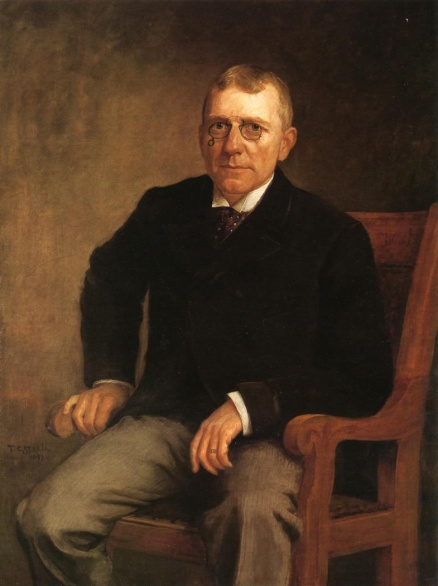
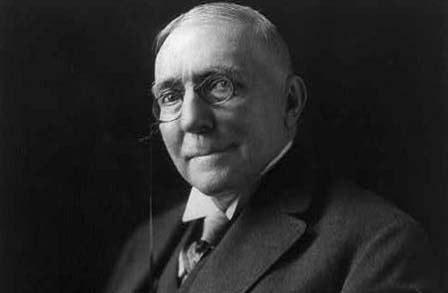
James Whitcomb Riley (October 7, 1849 – July 22, 1916) was an American writer, poet, and best-selling author. During his lifetime he was known as the “Hoosier Poet” and “Children’s Poet” for his dialect works and his children’s poetry. His poems tend to be humorous or sentimental. Of the approximately 1,000 poems Riley wrote, the majority are in dialect. His famous works include “Little Orphant Annie” and “The Raggedy Man”.
Riley began his career writing verses as a sign maker and submitting poetry to newspapers. Thanks in part to poet Henry Wadsworth Longfellow’s endorsement, he eventually earned successive jobs at Indiana newspaper publishers during the late 1870s. He gradually rose to prominence during the 1880s through his poetry reading tours. He traveled a touring circuit first in the Midwest, and then nationally, appearing either alone or with other famous talents. During this period Riley’s long-term addiction to alcohol began to affect his performing abilities, and he suffered financially as a result. However, once he extricated himself from a series of poorly negotiated contracts that sought to limit his earnings, he began to accumulate wealth and eventually became a financial success.
By the 1890s, Riley had become known as a bestselling author. His children’s poems were compiled into a book illustrated by Howard Chandler Christy. Titled Rhymes of Childhood, it was his most popular and sold millions of copies. As a poet, Riley achieved an uncommon level of fame during his lifetime. He was honored with annual Riley Day celebrations around the United States and was regularly called on to perform readings at national civic events. He continued to write and hold occasional poetry readings until a stroke paralyzed his right arm in 1910.
Riley’s chief legacy was his influence in fostering the creation of a Midwestern cultural identity and his contributions to the Golden Age of Indiana Literature. With other writers of his era, he helped create a caricature of Midwesterners and formed a literary community that produced works rivaling the established eastern literati. There are many memorials dedicated to Riley, including the James Whitcomb Riley Hospital for Children.


 The Write Stuff