
Thought it was time for me to start getting back to some of my regular features from days gone by. Figured Monday was a good day to start, and Classic Poetry has always run on a Monday, so … here we go. Another classic poem by one of my all-time favorites, James Whitcomb Riley. I know some folks aren’t fond of the dialect, but for me, it’s perfect, and really makes the poem. Hope you like this one. (As someone who is called Granny on a very regular basis, I couldn’t resist it! Happy reading!
Granny
JAMES WHITCOMB RILEY (1859 – 1916)
Granny’s come to our house,
And ho! my lawzy-daisy!
All the childern round the place
Is ist a-runnin’ crazy!
Fetched a cake fer little Jake,
And fetched a pie fer Nanny
And fetched a pear fer all the pack
That runs to kiss their Granny!
Lucy Ellen’s in her lap,
And Wade and Silas Walker
Both’s a-ridin’ on her foot,
And ’Pollos on the rocker;
And Marthy’s twins, from Aunt Marinn’s,
And little Orphant Annie,
All’s a-eatin’ gingerbread
And giggle-un at Granny!
Tells us all the fairy tales
Ever thought er wundered—
And ’bundance o’ other stories—
Bet she knows a hunderd!—
Bob’s the one fer “Whittington,”
And “Golden Locks” fer Fanny!
Hear ’em laugh and clap their hands,
Listenin’ at Granny!
“Jack the Giant-Killer” ’s good;
And “Bean-Stalk” ’s another!—
So’s the one of “Cinderell’”
And her old godmother;—
That-un’s best of all the rest—
Bestest one of any,—
Where the mices scampers home
Like we runs to Granny!
Granny’s come to our house,
Ho! my lawzy-daisy!
All the childern round the place
Is ist a-runnin’ crazy!
Fetched a cake fer little Jake,
And fetched a pie fer Nanny,
And fetched a pear fer all the pack
That runs to kiss their Granny!
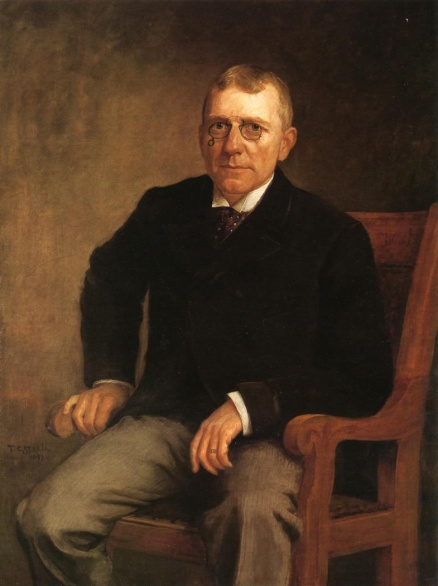
James Whitcomb Riley (October 7, 1849 – July 22, 1916) was an American writer, poet, and best-selling author. During his lifetime he was known as the “Hoosier Poet” and “Children’s Poet” for his dialect works and his children’s poetry. His poems tend to be humorous or sentimental. Of the approximately 1,000 poems Riley wrote, the majority are in dialect. His famous works include “Little Orphant Annie” and “The Raggedy Man”.
Riley began his career writing verses as a sign maker and submitting poetry to newspapers. Thanks in part to poet Henry Wadsworth Longfellow’s endorsement, he eventually earned successive jobs at Indiana newspaper publishers during the late 1870s. He gradually rose to prominence during the 1880s through his poetry reading tours. He traveled a touring circuit first in the Midwest, and then nationally, appearing either alone or with other famous talents. During this period Riley’s long-term addiction to alcohol began to affect his performing abilities, and he suffered financially as a result. However, once he extricated himself from a series of poorly negotiated contracts that sought to limit his earnings, he began to accumulate wealth and eventually became a financial success.
By the 1890s, Riley had become known as a bestselling author. His children’s poems were compiled into a book illustrated by Howard Chandler Christy. Titled Rhymes of Childhood, it was his most popular and sold millions of copies. As a poet, Riley achieved an uncommon level of fame during his lifetime. He was honored with annual Riley Day celebrations around the United States and was regularly called on to perform readings at national civic events. He continued to write and hold occasional poetry readings until a stroke paralyzed his right arm in 1910.
Riley’s chief legacy was his influence in fostering the creation of a Midwestern cultural identity and his contributions to the Golden Age of Indiana Literature. With other writers of his era, he helped create a caricature of Midwesterners and formed a literary community that produced works rivaling the established eastern literati. There are many memorials dedicated to Riley, including the James Whitcomb Riley Hospital for Children.

 The Write Stuff