
Starting a new series today that I hope you folks will enjoy. Since I’m not able to give my local wildlife talks at the present time, I decided it would be fun to share some of the tidbits from them here on TWS. I hope you’ll enjoy seeing a couple of interesting slides from various presentations I’ve done, and learning a few new things about wildlife, particularly wildlife found in Central Florida. And, as I mentioned in an earlier post, my good friend and fellow wildlife lover, Dennis Burnette, will be joining us when he can to share some wildlife posts of his own. Our posts won’t follow a strict scheduled, but will always be shared on Wednesdays, and we both hope you’ll enjoy the information we pass along.

I figured I’d get the ball rolling with a post on Florida’s most famous (notorious?) critter, the American Alligator. I’ll mostly be using photos taken by my good friend, the late Doug Little, who spent years leading ecotours on the St. Johns River. Happily, Doug gave me several hundred of his pictures to share wherever I wanted, including this photo of “Ol’ Tick,” a large, ancient alligator who had reserved this very spot along the river for his own exclusive use. (Would you challenge this guy? I think not.)
 Photo by Doug Little
Now … Exactly What Is an Alligator?
I’ve noticed that folks from other parts of the world often refer to alligators as “crocs,” but alligators and crocodiles are different animals, honest. Yes, it’s true that all alligators are crocodilians, but all crocodilians are definitely not alligators.
 (Trust Me: The Only Croc in this Picture is the Shoe)
To help sort it all out … or perhaps confuse you even more … consider this: There are 23 species of crocodilians, but only two of them are alligators. Yep. Just TWO.
23 Species of Crocodilians (Partial List)
6 CAIMANS, INCLUDING THESE TWO:
*Spectacled Caiman (Caiman crocodilus) – native from Mexico to Northern Argentina
*Black Caiman (Melanosuchus niger) – native to South America
14 CROCODILES, INCLUDING THESE FIVE:
*Australian saltwater crocodile (Crocodylus porosus) – native to Australia
*Australian freshwater crocodile (Crocodylus Johnstoni) – native to Australia
*Nile crocodile (Crocodylus niloticus) – native to Africa
*Mugger crocodile (Crocodylus palustris) – native to India
*Orinoco crocodile (Crocodylus intermedius) -native to South America
1 GHARIAL
*Gharial/Gavial – (Gavialis gangeticus) – native to Northern parts of India
AND … TADA …

Yep, you read right. Only TWO out of 23 crocodilians are alligators. The other 21 species fall under one of the three categories listed above.
I’m always amazed that out of the only two alligator species on earth, one lives in the southeastern part of the United States …

and the other one lives clear around the world in China! The Chinese alligator is restricted to the Yangtze River area, where the orange dot is in this illustration.

That seems pretty strange, but it’s true. The Chinese alligator is also a critically endangered species, and is a much smaller reptile than our American one. See?

The American alligator is a whole ‘nuther animal, as we say around these parts, and grows to a much, much larger size than their 5’ long Chinese counterparts. Here are some numbers that might surprise you:
AMERICAN ALLIGATOR STATISTICS & TIDBITS
Average Sized Males: 11 feet, 780 lbs
Average Sized Females: 8.5 feet, 201 lbs
Verified Record Size: 13.9 feet
Unverified Record Sizes: 17 to 19 feet
Common Reports in the Late 1800s: 16 to 20 feet
 Just think … this guy is nowhere near his potential full size!
MORE ALLIGATOR TIDBITS
*The American alligator is said to have the third strongest bite force of any living animal. (First and second place go to the saltwater crocodile and the Nile crocodile).
*The Florida Fish & Wildlife Conservation Commission considers alligators to be a “Keystone Species,” modifying wetlands during drought, and being vital to the health of their environment.
*Sometimes these predators eat wild grapes, elderberries, and citrus that grow alongside rivers and streams.

*The American alligator is the official state reptile for Florida, Louisiana, and Mississippi.
*A Miocene era alligator skull was found in Marion County, Florida. (Age estimates vary from 5 million to 23 million years old!)

*The old theory was that alligators continue to grow throughout their lives. New data indicates that growth stops at 25 to 30 years of age.
*The average lifespan of the American alligator is roughly the same as the average lifespan for humans.

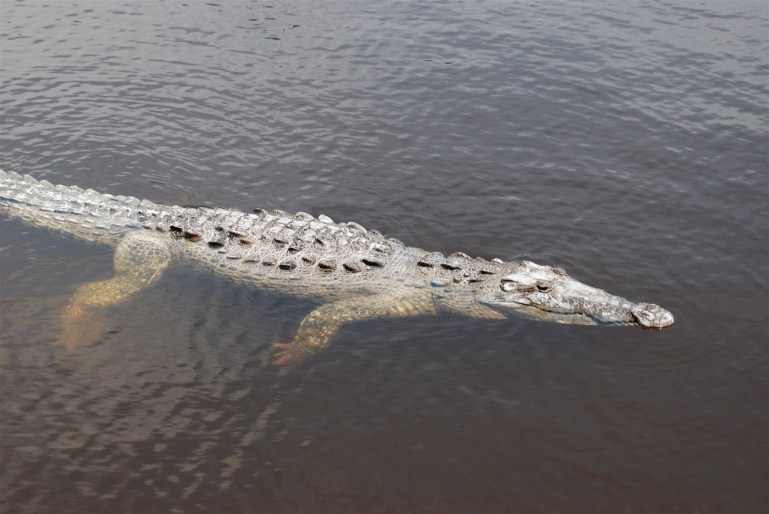
Now that I’ve told you all about alligators and crocodiles being two different critters, let me add that we DO have a species of crocodile in south Florida, down in the Everglades area. The species there is the American salt water crocodile (Crocodylus acutus), and is a completely different animal in both appearance and temperament than the American alligators we have throughout the entire state. You can tell them apart merely by looking at them, and here’s the scoop on that.

Check it out!
 Picture 1: Alligator on the left, crocodile on the right;
Picture 2: Alligator in top photo, crocodile in bottom one.

Notice the bigger, wider, heavier-looking, U-shaped head on the gators,
and the darker gray to black coloring, as compared to the V-shaped head
and lighter grayish-tan color on the crocs. It’s also of note that when the crocodile’s mouth is closed, you can see his top AND bottom teeth. Only the upper teeth are visible when an alligator’s mouth is closed. (It should go without saying if you are close enough to check their teeth, you should probably get the heck outta there!) 😁

One more comparison shot. Again, the alligator has a much more rounded, heavier looking head, compared to the croc, with its more slender, pointed snout. And, even though this croc is somewhat muddied up a bit, he is still lighter and more brownish in color than the gator. Crocs can range from light gray to a pale tan, but they are never the dark gray-to-black an adult alligator is. Yes, they both look like giant, toothy lizards, but it’s really not that hard to tell them apart.
As for temperament, in general crocodiles tend to be a good bit more aggressive than alligators, though I would not recommend going swimming with either one. (More on that topic later.)
I think this is probably a good place to stop for today, and I
hope you enjoyed learning a bit about the
American alligator.

Please join me next time for:
AMERICAN ALLIGATOR PART 2: Bringing Up Baby




 The Write Stuff