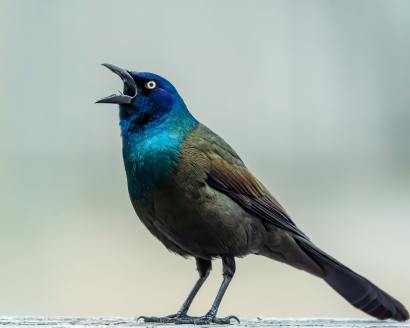
 Purple (Common) Grackle
Alas! All but one or two of my gorgeous little painted buntings have moved on, hoping for warmer weather along their journey northward to their summer/nesting grounds. (I’m afraid they may be a bit disappointed about that, at least for another week or two, but I wish them safe journeys.)

At my feeder, the grackles have taken over, both common and boat-tailed varieties. Jostling, shoving, crowding each other off the tray in their fever to stock up for their own northward journey. Today, because I love them dearly, and because I had a request from Patty, I’m going to share one of my favorite poems again. It captures the exuberance and beauty of these birds perfectly, along with so much more. And it has inspired me to start a new series of posts. Will tell you more on that later. For now, even though spring will soon be here, I hope you’ll enjoy Amy Lowell’s tribute to autumn’s arrival, Purple Grackles. (It’s long, but it’s well worth savoring every word.)
PURPLE GRACKLES by Amy Lowell (1874 – 1925)
The grackles have come.
The smoothness of the morning is puckered with their incessant chatter.
A sociable lot, these purple grackles.
Thousands of them strung across a long run of wind,
Thousands of them beating the air-ways with quick wing-jerks,
Spinning down the currents of the South.
Every year they come,
My garden is a place of solace and recreation evidently,
For they always pass a day with me.
With high good nature they tell me what I do not want to hear.
The grackles have come.
I am persuaded that grackles are birds;
But when they are settled in the trees
I am inclined to believe them fruits
And the trees turned hybrid blackberry vines.
Blackness shining and bulging under leaves,
Does not that mean blackberries, I ask you?
Nonsense! The grackles have come.
Nonchalant highwaymen, pickpockets, second-story burglars,
Stealing away my little hope of Summer.
There is no stealthy robbing in this.
Who ever heard such a gabble of thieves’ talk!
It seems they delight in unmasking my poor pretense.
Yes, now I see that the hydrangea blooms are rusty;
That the hearts of the golden glow are ripening to lustreless seeds;
That the garden is dahlia-coloured,
Flaming with its last over-hot hues;
That the sun is pale as a lemon too small to fill the picking-ring.
I did not see this yesterday,
But today, the grackles have come.
They drop out of the trees
And strut in companies over the lawn,
Tired of flying, no doubt;
A grand parade to limber legs and give wings a rest.
I should build a great fish-pond for them,
Since it is evident that a bird-bath, meant to accommodate two goldfinches at most,
Is slight hospitality for these hordes.
Scarcely one can can get in,
They all peck and scrabble so,
Crowding, pushing, chasing one another up the bank with spread wings.
“Are we ducks, you, owner of such inadequate comforts,
That you offer us lily-tanks where one must swim or drown,
Not stand and splash like a gentleman?”
I feel the reproach keenly, seeing them perch on the edges of the tanks, trying the depth with a chary foot,
And hardly able to get their wings under water in the bird-bath.
But there are resources I had not considered,
If I am bravely ruled out of count.
What is that thudding against the eaves just beyond my window?
What is that spray of water blowing past my face?
Two–three–grackles bathing in the gutter,
The gutter providentially choked with leaves.
I pray they think I put the leaves there on purpose;
I would be supposed thoughtful and welcoming
To all guests, even thieves.
But considering that they are going South and I am not,
I wish they would bathe more quietly,
It is unmannerly to flaunt one’s good fortune.
They rate me of no consequence,
But they might reflect that it is my gutter.
I know their opinion of me,
Because one is drying himself on the windowsill
Not two feet from my hand.
His purple neck is sleek with water,
And the fellow preens his feathers for all the world as if I were a fountain statue.
If it were not for the window,
I am convinced he would light on my head.
Tyrian-feathered freebooter,
Appropriating my delightful gutter with so extravagant an ease,
You are as cool a pirate as ever scuttled a ship,
And are you not scuttling my Summer with every peck of your sharp bill?
But there is a cloud over the beech-tree,
A quenching cloud for lemon-livered suns.
The grackles are all swinging in the treetops,
And the wind is coming up, mind you.
That boom and reach is no Summer gale,
I know that wind,
It blows the Equinox over seeds and scatters them.
It rips petals from petals, and tears off half-turned leaves.
There is rain on the back of that wind.
Now I would keep the grackles,
I would plead with them not to leave me.
I grant their coming, but I would not have them go.
It is a milestone, this passing of grackles.
A day of them, and it is a year gone by.
There is magic in this and terror,
But I only stare stupidly out of the window.
The grackles have come.
Come! Yes, they surely came.
But they have gone.
A moment ago the oak was full of them,
They are not there now.
Not a speck of a black wing,
Not an eye-peep of a purple head.
The grackles have gone,
And I watch an Autumn storm
Stripping the garden,
Shouting black rain challenges
To an old, limp Summer
Laid down to die in the flower beds.





 The Write Stuff