Fantasy and the problem with Tolkien

castle of dreams

Painting: Sue Vincent

It has to be said that Tolkien causes problems. Quite apart from being so addictive that, once read, you are likely to go back and read the books again, you may never find anywhere quite as rich as  Middle Earth within the pages of another book.

Anyone whose introduction to fantasy is via The Hobbit and Lord of the Rings, will have a fabulously detailed, multi-layered and multicultural world permanently established in their imagination. Especially if you go on to read The Silmarillion too and become aware of the rich complexity and authenticity of the languages, histories and mythologies he created as the backdrop for his world. Tolkien’s elves, orcs and wizards will quickly become the standard by which all others are judged. The sheer scope of the story means that just about every possible trope is used, and every mythical or magical species is covered, along with a goodly armoury of magical weapons and the central motif of the Ring of Power.

Is there any reason to read or to attempt to write fantasy any more? It is almost impossible to write high fantasy these days without being accused of stealing ideas from Tolkien. For aficionados of Middle Earth, it is even harder to read fantasy without drawing comparisons. While creating what is arguably the best fantasy ever, the author has also inadvertently ruined the very genre he brought to popularity.

Or has he?

Our teacher read The Hobbit to the class of eager listeners in junior school, but I did not read Lord of the Rings until I was in my teens. Even though the Narnia stories of C.S. Lewis were already so well-thumbed that the books were disintegrating, it was not until I read Tolkien that I heard of fantasy as a genre. There were only stories, fairytales, myths and legends. Oddly enough, that did not stop me from enjoying them all equally. I was reading tales of giants and talking trees, elves, trolls and goblins long before I came across hobbits. Although perfected by Tolkien, the lineaments of such characters were already drawn in my mind by the fairy-tales of early childhood. The quest is a familiar concept in myth and Excalibur is surely the most famous sword with which to prove kingship, even more so than Andúril, while the popular version of Merlin must surely outrank even Gandalf.

The first officially designated fantasy I read after Tolkien was Stephen Donaldson’s Lord Foul’s Bane, the opening book of the Chronicles of Thomas Covenant. Lo and behold, the hero, Covenant, had a magical ring whose powers could save or damn the world. The ring was both feared and sought by the dark Lord Foul as Covenant traversed a land peopled with both characters and situations that could have been lifted directly from Tolkien. The parallels are striking in places, from the tree-city to the goblins, the extra-special horses to the healing vegetation. Yet the writer managed to make me forget all that by his creation of the Land. This is no Middle Earth… and the parallels that at first seemed gratingly familiar, soon diverged and developed into a rich tapestry of a tale with its own unique character and ‘feel’. Other fantasies followed, each creating a landscape and feeling entirely different from the last… and each sharing something with the reader that was unique in spite of a common heritage.

The truth is, we cannot blame it all on Tolkien. He himself drew heavily upon myth and legend, particularly the Norse myths. Most of the characters and storylines he uses so magnificently are familiar from our oldest tales. Even the Ring was not his idea. Odin, the Norse god, had a magic ring, although admittedly, Draupnir was an arm ring. Plato speaks of the Ring of Gyges that conferred invisibility on its wearer. Wagner’s Ring Cycle tells the story of a magical ring whose power resides in the ‘denial of love’ and can bring the entire world under subjugation. And every mythology has its Dark Lord in one form or another.

Fantasy is not just a way to escape reality for a while, it offers a means of exploring, understanding and explaining it. The battle between ‘good’ and ‘evil’ is something we see played out on both the world stage and within our own natures every day. The sustaining qualities of the Quest, such as loyalty, endurance and vision, are those that serve us, while the betrayals and obstacles mirror our own. Just as stories reflect our own so do our own lives reflect the greater life around us. Just as we played at being grown-ups when we were children, fantasy allows the mind to experience a new mode of being in a symbolic landscape that can enrich our lives and present us with questions we might never otherwise consider. Without realising, we may learn much from a well-crafted tale.

Does it matter if it has been ‘done before’ no matter how brilliantly, when all our stories follow threads that lead back to the beginning of mankind’s fascination with storytelling? Stories have always taught through entertainment, by capturing the attention and imagination, engaging the emotions and settling themselves firmly in memory. Each tale appeals to something within us that answers with its own voice. Every storyteller brings something of themselves, something unique, to the tale.

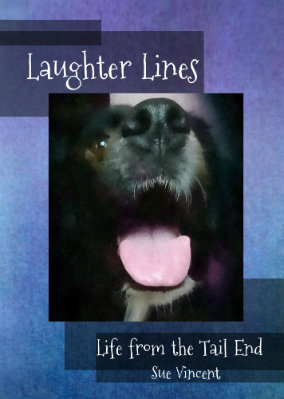
#ExcerptWeek #SueVincent George and the Dragon from #LaughterLines

Laughter 12

NOTE: My apology for how long it took me to get this to show up properly on WordPress. Poetry spacing can be really tricky, and I can’t use the “Continue Reading” spacer, either, because it messed it all up, and I had to start over. GAH! But at least you can read it now, in proper verses. I think. 😀

Sue has recently started following us here at The Write Stuff, and has asked me to share one of her poems with you, as part of excerpt week. I’m very happy to do so, as it made me laugh out loud several times. It’s longer than some of you might be used to, but I promise you, it’s well worth taking the time to read. VERY amusing, indeed. Thank you for sharing, Sue, and I’ll be tweeting and sharing this one. You guys, hope you’ll remember to do so as well. The book and buying info is included at the end of the poem. Check it out!

~~~

George and the Dragon

“Nah, sithee,” said Granny, “Just set thee dahn ‘ere,
An’ I’ll tell the a tale old and true,
Of ‘ow good Saint George slew a dragon one day
An’ all dressed in a metal suit too.
 
It were like this…” she said as she warmed to her tale
With her listeners huddled around,
“The beast ‘ad moved in and set up ‘is abode
In a cave on the best ‘unting ground.    
   
The king weren’t too pleased, it ‘ad etten his ‘oss
And the best of the royal deer too.
‘To be fair,’ said the mage, his opinion asked,
‘What else would you expect it to do?’                
   
‘I’ve heard they like maidens,’ his Majesty said,
‘Give it one, then we’ll be in the clear.’
‘A maiden, my liege?’ said the mage in surprise,
‘Tha’ll be lucky to find one round ‘ere!’    
     
The King scratched ‘is head, there was something in that
‘Cause for maidens… ‘e’d known a fair few,
‘We’ll send out a search party over the land…
It’ll give the lads something to do.’

The very next morning the lads all set off
All caparisoned, armoured and gay,
Trouble was, they were ‘unting for pretty young maids
And wherever they found one, they’d stay.

Now the dragon had ‘etten the rest of the deer
And had now set to work on the cows,
His Majesty went to his daughter and said,
‘Hast thou kept all thy maidenly vows?’

‘But of course, Dad!’ she cried, ‘I’ve had chance for nowt else
When I’m shut in this castle all day!’
‘Just as well,’ said the King, ‘ ‘Cause we’re in a reyt mess.
Get your coat and we’ll be on our way.’

The princess was pretty with long golden hair,
The king thought he was onto a winner;
‘Now just you ‘ang on,’ she said raising her chin,
‘I can tell thee, I’m no dragon’s dinner!’

Now t’lass were fed up being shut up inside
And was ‘atching a plot of ‘er own.
‘I’ve got some conditions before we set off…
Get a pen, write it down… make it known’

Her Dad ‘ad to do as his daughter prescribed
Though her orders were not what he’d like…
‘Full half of my realm to your rescuer, lass?’
‘Write it down, Dad, or just take a hike.’

He did as she said, then she patted his hand,
‘Look, the rest of the plan’s none so bad…
I’ll marry him too, then you lose bugger all;
He can be the heir you never ‘ad.’

She had a good point and the orders were read
Through the length and the breadth of the city.
But no-one stepped up, ‘cause the dragon was big,
Even if the lass was rich and pretty.

There was only young George, at the tavern one night;
It were after bevy or seven,
His mates egged ‘im on and he drunkenly said,
‘Well, it sounds like a deal made in heaven.’

His pal were a blacksmith and all through the night
With the hammer and metal they clattered,
And made him a suit; though it rattled a bit,
That protected the assets that mattered.

He went to the king and his offer was met
With a fair bit of mocking and laughter;
‘Is there anyone else ‘ere who fancies the job?’
Asked the king… there was silence thereafter.

Now morning had come and poor George sobered up
And berated himself at ‘is folly.
‘Tha’s no gumption, lad,’ said his hungover head,
‘And in fact, tha’s an absolute wally.’

Too late to back out with the town at his feet
And the princess out there with the dragon,
‘Now if tha survives,’ the lad thought to himself,
‘Georgie boy, tha must go on the wagon.’

The cave mouth looked dark as ‘e rattled in close
And ‘e knew that ‘is chances were slim,
But with the town watching ‘e had little choice
As ‘e crept where the shadows were dim.

The suit was a pain and it chafed all the time
In some places ‘e’d rather not mention,
George swore as he crept in the cavern’s dark door
That from now on ‘e’d stick to abstention.

The townsfolk looked on and the king wrung ‘is hands
As the lad disappeared in the gloom.
They wondered how long they’d be waiting to see
If the lad really ‘ad met his doom.

Strange noises were issuing out from the cave,
And the crowd winced and cringed as they listened,
Then out came the princess with George by her side
They were carrying something that glistened.

The folk never learned just what George found inside
And poor George was the only one knowing;
The princess was cooking a nice dragon stew
Over dragon-lit embers a-glowing.

‘I skinned it,’ she said, ‘as the scales are quite tough,’
And George looked at the princess in horror.
‘You might as well eat just to keep up your strength,’
She continued, ‘You’ll need it tomorrow.’

‘Just do as I tell you and make no mistake
I will make sure they treat you right well,
But cross me just once,’ she said waving her spear,
‘Georgie boy, and I’ll make your life hell.’

So they married next day amid feasting and joy
And the wine and the mead that flowed free,
But George just sat quiet and did as she bid,
Drinking naught but a nice cup of tea.

Not a drop touched his lips of the hard stuff that day,
And his manner seemed quiet and charming,
Yet under his breath he could be heard to pray
Which the courtiers found quite disarming.

‘The man is reformed, hallelujah,’ they said,
And they found his reserve to be quaint,
But the princess just smiled, knowing better than they
Just which dragon had made George a saint.”

“Don’t be daft, Granny, please,” a dissenting voice said,
“That is not how they tell it at all.”
“Oh no?” she replied, and they followed her gaze
To the dragonskin pinned on the wall.

Laughter Lines (Amazon.com)
Laughter Lines (Amazon.uk)