
#ClassicPoetry – #JamesWhitcombRiley – “Granny”

Thought it was time for me to start getting back to some of my regular features from days gone by. Figured Monday was a good day to start, and Classic Poetry has always run on a Monday, so … here we go. Another classic poem by one of my all-time favorites, James Whitcomb Riley. I know some folks aren’t fond of the dialect, but for me, it’s perfect, and really makes the poem. Hope you like this one. (As someone who is called Granny on a very regular basis, I couldn’t resist it! Happy reading!


Granny
JAMES WHITCOMB RILEY (1859 – 1916)


Granny’s come to our house,
And ho! my lawzy-daisy!
All the childern round the place
    Is ist a-runnin’ crazy!
Fetched a cake fer little Jake,
    And fetched a pie fer Nanny
And fetched a pear fer all the pack
    That runs to kiss their Granny!

Lucy Ellen’s in her lap,
    And Wade and Silas Walker
Both’s a-ridin’ on her foot,
    And ’Pollos on the rocker;
And Marthy’s twins, from Aunt Marinn’s,
    And little Orphant Annie,
All’s a-eatin’ gingerbread
    And giggle-un at Granny!

Tells us all the fairy tales
    Ever thought er wundered—
And ’bundance o’ other stories—
    Bet she knows a hunderd!—
Bob’s the one fer “Whittington,”
    And “Golden Locks” fer Fanny!
Hear ’em laugh and clap their hands,
    Listenin’ at Granny!

“Jack the Giant-Killer” ’s good;
    And “Bean-Stalk” ’s another!—
So’s the one of “Cinderell’”
    And her old godmother;—
That-un’s best of all the rest—
    Bestest one of any,—
Where the mices scampers home
    Like we runs to Granny!

Granny’s come to our house,
    Ho! my lawzy-daisy!
All the childern round the place
    Is ist a-runnin’ crazy!
Fetched a cake fer little Jake,
    And fetched a pie fer Nanny,
And fetched a pear fer all the pack
    That runs to kiss their Granny!
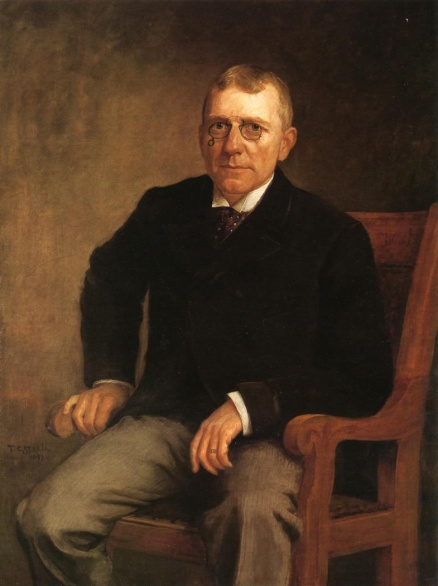

James Whitcomb Riley (October 7, 1849 – July 22, 1916) was an American writer, poet, and best-selling author. During his lifetime he was known as the “Hoosier Poet” and “Children’s Poet” for his dialect works and his children’s poetry. His poems tend to be humorous or sentimental. Of the approximately 1,000 poems Riley wrote, the majority are in dialect. His famous works include “Little Orphant Annie” and “The Raggedy Man”.

Riley began his career writing verses as a sign maker and submitting poetry to newspapers. Thanks in part to poet Henry Wadsworth Longfellow’s endorsement, he eventually earned successive jobs at Indiana newspaper publishers during the late 1870s. He gradually rose to prominence during the 1880s through his poetry reading tours. He traveled a touring circuit first in the Midwest, and then nationally, appearing either alone or with other famous talents. During this period Riley’s long-term addiction to alcohol began to affect his performing abilities, and he suffered financially as a result. However, once he extricated himself from a series of poorly negotiated contracts that sought to limit his earnings, he began to accumulate wealth and eventually became a financial success.

By the 1890s, Riley had become known as a bestselling author. His children’s poems were compiled into a book illustrated by Howard Chandler Christy. Titled Rhymes of Childhood, it was his most popular and sold millions of copies. As a poet, Riley achieved an uncommon level of fame during his lifetime. He was honored with annual Riley Day celebrations around the United States and was regularly called on to perform readings at national civic events. He continued to write and hold occasional poetry readings until a stroke paralyzed his right arm in 1910.

Riley’s chief legacy was his influence in fostering the creation of a Midwestern cultural identity and his contributions to the Golden Age of Indiana Literature. With other writers of his era, he helped create a caricature of Midwesterners and formed a literary community that produced works rivaling the established eastern literati. There are many memorials dedicated to Riley, including the James Whitcomb Riley Hospital for Children.
#Classic Poetry – #JamesWhitcombRiley – #TheDaysGoneBy

Time once again for another sample of Classic Poetry. I hope you enjoy this one by James Whitcomb Riley. It always strikes a chord with me. Happy reading!  😀


The Days Gone By
JAMES WHITCOMB RILEY (1859 – 1916)

O the days gone by! O the days gone by!
The apples in the orchard, and the pathway through the rye;
The chirrup of the robin, and the whistle of the quail
As he piped across the meadows sweet as any nightingale;
When the bloom was on the clover, and the blue was in the sky,
And my happy heart brimmed over in the days gone by.

In the days gone by, when my naked feet were tripped
By the honey-suckle’s tangles where the water-lilies dipped,
And the ripples of the river lipped the moss along the brink
Where the placid-eyed and lazy-footed cattle came to drink,
And the tilting snipe stood fearless of the truant’s wayward cry
And the splashing of the swimmer, in the days gone by.

O the days gone by! O the days gone by!
The music of the laughing lip, the luster of the eye;
The childish faith in fairies, and Aladdin’s magic ring—
The simple, soul-reposing, glad belief in everything,
When life was like a story, holding neither sob nor sigh,
In the golden olden glory of the days gone by.


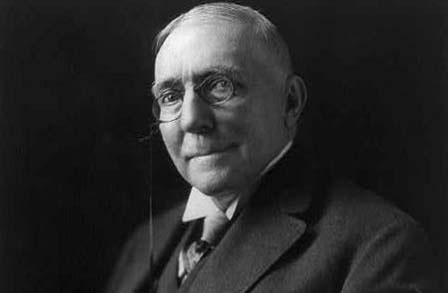
James Whitcomb Riley (October 7, 1849 – July 22, 1916) was an American writer, poet, and best-selling author. During his lifetime he was known as the “Hoosier Poet” and “Children’s Poet” for his dialect works and his children’s poetry. His poems tend to be humorous or sentimental. Of the approximately 1,000 poems Riley wrote, the majority are in dialect. His famous works include “Little Orphant Annie” and “The Raggedy Man”.

Riley began his career writing verses as a sign maker and submitting poetry to newspapers. Thanks in part to poet Henry Wadsworth Longfellow’s endorsement, he eventually earned successive jobs at Indiana newspaper publishers during the late 1870s. He gradually rose to prominence during the 1880s through his poetry reading tours. He traveled a touring circuit first in the Midwest, and then nationally, appearing either alone or with other famous talents. During this period Riley’s long-term addiction to alcohol began to affect his performing abilities, and he suffered financially as a result. However, once he extricated himself from a series of poorly negotiated contracts that sought to limit his earnings, he began to accumulate wealth and eventually became a financial success.

By the 1890s, Riley had become known as a bestselling author. His children’s poems were compiled into a book illustrated by Howard Chandler Christy. Titled Rhymes of Childhood, it was his most popular and sold millions of copies. As a poet, Riley achieved an uncommon level of fame during his lifetime. He was honored with annual Riley Day celebrations around the United States and was regularly called on to perform readings at national civic events. He continued to write and hold occasional poetry readings until a stroke paralyzed his right arm in 1910.

Riley’s chief legacy was his influence in fostering the creation of a Midwestern cultural identity and his contributions to the Golden Age of Indiana Literature. With other writers of his era, he helped create a caricature of Midwesterners and formed a literary community that produced works rivaling the established eastern literati. There are many memorials dedicated to Riley, including the James Whitcomb Riley Hospital for Children.


Hope you enjoyed reading another classic poem by
James Whitcomb Riley, who’s always been a favorite of mine.
His poems are a delight to read aloud!

#ClassicPoetry – #LittleOrphantAnnie – #JamesWhitcombRiley – #Halloween

Thought I’d share one more “classic” poem by Indiana’s Poet Laureate, James Whitcomb Riley. Halloween is coming up next week, and this was always one of my favorite “spooky” poems.  Next time around, we’ll be taking a look at a completely different poet and her work, but for now, this feels more appropriate. Enjoy!


Little Orphant Annie

James Whitcomb Riley – 1849-1916

Little Orphant Annie’s come to our house to stay,
An’ wash the cups an’ saucers up, an’ bresh the crumbs away,
An’ shoo the chickens off the porch, an’ dust the hearth, an’ sweep,
An’ make the fire, an’ bake the bread, an’ earn her board-an’-keep;
An’ all us other childern, when the supper things is done,
We set around the kitchen fire an’ has the mostest fun
A-list’nin’ to the witch-tales ‘at Annie tells about,
An’ the Gobble-uns ‘at gits you
             Ef you
                Don’t
                   Watch
                      Out!

Onc’t they was a little boy wouldn’t say his prayers,—
So when he went to bed at night, away up stairs,
His Mammy heerd him holler, an’ his Daddy heerd him bawl,
An’ when they turn’t the kivvers down, he wasn’t there at all!
An’ they seeked him in the rafter-room, an’ cubby-hole, an’ press,
An’ seeked him up the chimbly-flue, an’ ever’wheres, I guess;
But all they ever found was thist his pants an’ roundabout–
An’ the Gobble-uns’ll git you
             Ef you
                Don’t
                   Watch
                      Out!

An’ one time a little girl ‘ud allus laugh an’ grin,
An’ make fun of ever’one, an’ all her blood an’ kin;
An’ onc’t, when they was “company,” an’ ole folks was there,
She mocked ‘em an’ shocked ‘em, an’ said she didn’t care!
An’ thist as she kicked her heels, an’ turn’t to run an’ hide,
They was two great big Black Things a-standin’ by her side,
An’ they snatched her through the ceilin’ ‘fore she knowed what she’s about!
An’ the Gobble-uns’ll git you
             Ef you
                Don’t
                   Watch
                      Out!

An’ little Orphant Annie says when the blaze is blue,
An’ the lamp-wick sputters, an’ the wind goes woo-oo!
An’ you hear the crickets quit, an’ the moon is gray,
An’ the lightnin’-bugs in dew is all squenched away,–
You better mind yer parents, an’ yer teachers fond an’ dear,
An’ churish them ‘at loves you, an’ dry the orphant’s tear,
An’ he’p the pore an’ needy ones ‘at clusters all about,
Er the Gobble-uns’ll git you
             Ef you
                Don’t
                   Watch
                      Out!


Happy Halloween Next Week, Everybody!
(And be sure not to let the Gobble-uns get you!)

#ClassicPoetry – #JamesWhitcombRiley – #FrostyPumpkins – #HappyFall

I know we have a lot of poets and poetry lovers in our writing community, and I really enjoy all the new and unusual forms. I do, however, still have a great fondness for the poetry I enjoyed years ago, many from days long gone by, even then. With that in mind, I decided to start sharing some of my favorite poems from those days of yore now and then. Hope you’ll enjoy some of these as much as I do.

In honor of the official arrival of fall, here’s one I’ve always loved. Keep in mind that Riley generally wrote his works in dialect, which many, including me, consider part of the charm. It might take some getting used to, but I think you’ll find he’s captured the spirit of autumn very, very well. 

When the Frost is on the Punkin
BY JAMES WHITCOMB RILEY (1849 – 1916)

When the frost is on the punkin and the fodder’s in the shock,
And you hear the kyouck and gobble of the struttin’ turkey-cock,
And the clackin’ of the guineys, and the cluckin’ of the hens,
And the rooster’s hallylooyer as he tiptoes on the fence;
O, it’s then’s the times a feller is a-feelin’ at his best,
With the risin’ sun to greet him from a night of peaceful rest,
As he leaves the house, bareheaded, and goes out to feed the stock,
When the frost is on the punkin and the fodder’s in the shock.

They’s something kindo’ harty-like about the atmusfere
When the heat of summer’s over and the coolin’ fall is here—
Of course we miss the flowers, and the blossums on the trees,
And the mumble of the hummin’-birds and buzzin’ of the bees;
But the air’s so appetizin’; and the landscape through the haze
Of a crisp and sunny morning of the airly autumn days
Is a pictur’ that no painter has the colorin’ to mock—
When the frost is on the punkin and the fodder’s in the shock.

The husky, rusty russel of the tossels of the corn,
And the raspin’ of the tangled leaves, as golden as the morn;
The stubble in the furries—kindo’ lonesome-like, but still
A-preachin’ sermuns to us of the barns they growed to fill;
The strawstack in the medder, and the reaper in the shed;
The hosses in theyr stalls below—the clover over-head!—
O, it sets my hart a-clickin’ like the tickin’ of a clock,
When the frost is on the punkin and the fodder’s in the shock!

Then your apples all is gethered, and the ones a feller keeps
Is poured around the celler-floor in red and yeller heaps;
And your cider-makin’ ’s over, and your wimmern-folks is through
With their mince and apple-butter, and theyr souse and saussage, too! …
I don’t know how to tell it—but ef sich a thing could be
As the Angels wantin’ boardin’, and they’d call around on me
I’d want to ’commodate ’em—all the whole-indurin’ flock—
When the frost is on the punkin and the fodder’s in the shock!


James Whitcomb Riley (October 7, 1849 – July 22, 1916) was an American writer, poet, and best-selling author. During his lifetime he was known as the “Hoosier Poet” and “Children’s Poet” for his dialect works and his children’s poetry. His poems tend to be humorous or sentimental. Of the approximately 1,000 poems Riley wrote, the majority are in dialect. His famous works include Little Orphant Annie and The Raggedy Man“.


Hope you enjoyed this one, and that it brought a touch of autumn to remembrances of times gone by! I’ll be sharing another by Riley in two weeks, and then will move on to many other poets I’ve loved over the years.

But for now, HAPPY FALL Y’ALL!