Don’t worry: I’m not shirtless on my book cover

image By Ned Hickson
We’ve all heard the adage about not judging a book by it’s cover. And while that’s a terrific sentiment when it comes to people, let’s be honest in admitting the cover of a book is the first thing we judge. There’s a reason the heroine on a romance novel looks like a hair products model and not someone from an anti-drug campaign. Taking it a step further, from a woman’s perspective, would you want to thumb through the latest issue of Playgirl if Pee Wee Herman was on the cover?

OK, fine. Two of you would. Obviously, choosing a book is the least of your problems.

However, after conducting a random poll of 10 women in our office, they unanimously agreed, given a choice, they would rather see ME than Pee Wee Herman — which doesn’t really say as much about my masculinity as it does about our need for better vision coverage. Regardless, I will claim that as a victory.

Getting back to book covers… I was going to be on one last October. I’d like to tell you it was on a Harlequin Romance novel because they said they were looking for the next Fabio, “except without all the rugged good looks and muscles that distract from a book’s title. If less is more, Ned Hickson gives us more than we imagined possible.”

That’s what I’d like to tell you. But the fact is it’s MY book and, because it’s humorous, the publisher felt my face would be the perfect selling point. For obvious reasons, I was concerned that my anti-Fabio-ness would indeed prove so compelling that no one would notice the title. Or the book, for that matter. Kind of like those really funny commercials during the Super Bowl that no one remembers what was being advertised.

“I saw a book with this guy on the cover. MAN did he look funny!”
“That sounds great! What was the book?”
“Wa-huh…?”

Because of this, I think we can all agree deciding on a book cover design is one of the most crucial decisions you’ll make as an author, right along with your book’s title, what photo to use for the author bio, and whether to wear socks with your Penny Loafers during book readings. (For the record, as an Oregonian, I wear hiking boots 90 percent of the time. The rest of the time I am sleeping. However, I keep my hiking boots next to the bed just in case I sleepwalk.)

Obviously, the objective of any book cover is to catch the eye and distinguish itself from the hundreds of titles on the same shelf or eBook scroll bar. In the end, it really comes down to two main decisions:

Font
Graphic/image

While there are literally a bazillion different kids of fonts out there (seriously, I counted them), they boil down to six main categories. The basic rules with fonts are 1) never use more than one font from the same category, and 2) always use two different fonts on your cover. This will ensure clear distinction between the title and the author’s name or tag line. Using three different font styles begins to look confusing. Especially when translated into Chinese; particularly if you don’t read Chinese.

Choose fonts that capture the feel of your book but that also compliment each other by distinguishing themselves from each other. In short, when picking font styles, you’re looking for the Kim Kardashian and Kanye West of the font world.

Next comes deciding between an illustration or photo image for your book cover. Again, it really depends on the feel or “mood” you are trying to evoke. Romance covers tend to look dreamy with handwritten-type fonts from the Script and Old Style families. Images are generally graphic illustrations that leave something to the imagination of the reader. Young adult designs are edgier, with stark color contrasts and crisp font styles from the Decorative or Modern families. The main focus of YA covers leans toward a strong female image. This is opposed to Romance covers, which almost always feature a muscular, shirtless male looking as though he just found a woman while making the bed.

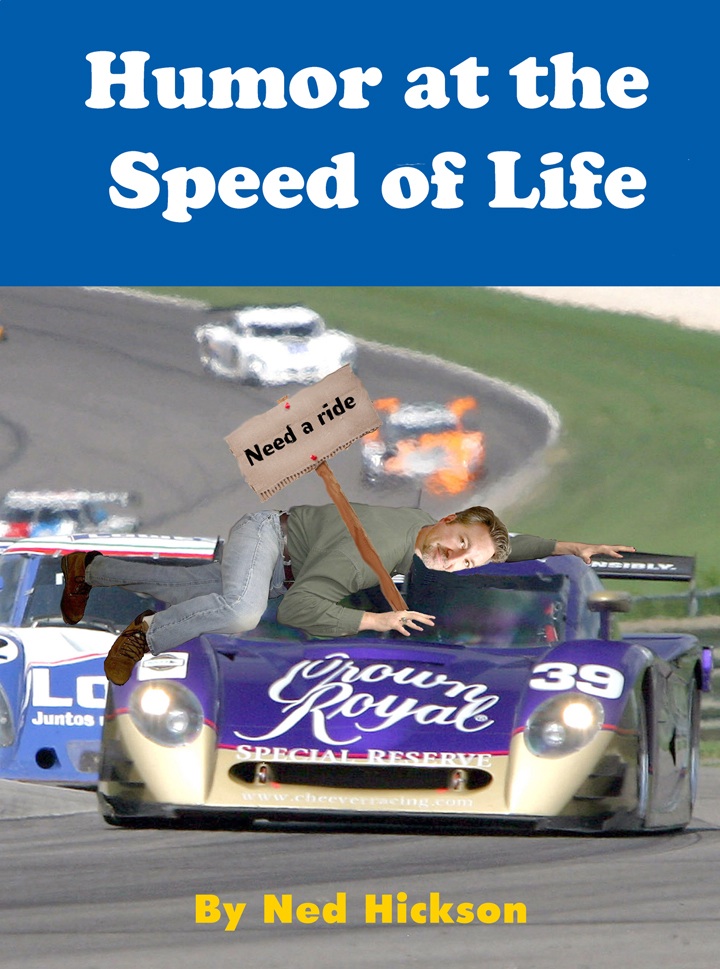
In my case, I have decided against going shirtless on the cover. Nor was I going be holding a woman wrapped in any kind of lacy robe or bed sheet. Given that the title is Humor At the Speed of Life, we originally decided to go with a photo, taken at a local speedway, where I was poised to race a pair of dragsters with my mini van. Probably while pushing it. That pretty much sums up the top speed of my life.
image

Would that be eye-catching enough? Would it stand out from the other books out there? I can’t say for sure because we changed the cover to this:

image

Why?

Because we eventually decided the kid with the goofy expression was not only more eye catching than me, but is probably going to grow up to be better looking. It’s actually a photo I took several years ago of my son’s friend while they were at the carnival. That’s the back of my son’s head in the foreground. He gets asked for autographs all the time now from people standing behind him in line. Another reason we went with that cover design is because it’s the same image that’s on my blog header, which hopefully readers would recognize if they saw it in a store, online or passing by their prison cell on a library cart. We also changed the font a bit to make it more clean, as well as changed the color scheme to match those in the photo.

The end result is a more vibrant, clean cover with an image that never fails to make people chuckle or even laugh out loud. Not that my being shirtless wouldn’t have the same effect.

Now if you’ll excuse me, I’m going to see if I can get Fabio to help push start my van…

imageNed Hickson is a syndicated columnist with News Media Corporation. His first book, Humor at the Speed of Life, is available from Port Hole Publications, Amazon.com or Barnes & Noble.

Do publishers really give a [Tweet] about a writer’s social media presence?

image By Ned Hickson

Welcome to this week’s writing tip, which is advice 50 Shades author E.L. James has called “My literary yardstick, which I’d like to break over someone’s…”

But enough accolades!

This week’s writing topic was actually suggested by talented writer, mom and blogger Michelle at MamaMickTerry, who asked:

Dear Mr. Hickson: Does having a blog help or hinder getting published?

She followed this up a short time later, after what I’m guessing was a glass or two of wine, with a more specific question:

Listen here, Neddy-O: Do you think publishers really give a [TWEET] about a writer’s social media presence? DO you? And hey, is it just me or does Thor’s hair need some de-tangler?

The short answer to Michelle’s question is that, while there are certainly arguments for and against the merits of the exposure one gets from traveling between worlds, most women wouldn’t care if Thor was bald. Ok, no woman really cares.

The long answer, as you might’ve guessed, is a little more complicated and actually has nothing to do with Thor’s choice of hair products. Though I realize that most women have stopped reading this post to Google Chris Hemsworth — Fine, all women — I still plan to answer Michelle’s question regarding the value of social media in the eyes of publishers who, coincidentally, almost never look like Thor.

On the surface, the advantages of establishing a blog and linking it to social media outlets like Facebook, Twitter, Tumbler, MySpace and others seems pretty obvious. The bigger your presence in the cyberworld and the larger your following, the more likely your book will catch on and be embraced in the world that truly counts: The buying world.

For those who thought I was going to say the world of “Asgard,” I really need you to close that Chris Hemsworth window on your monitor.

Keep in mind that, particularly for a writer without a previous track record, a large online readership can get a publisher or agent to at least raise an eyebrow after reading a well-written query letter or email about your book. For this reason, it’s always a good idea to include direct links to your blog and other active social media sites at the end of your query, as well as a link to a sample chapter online. Unless specifically requested, don’t ever include an attachment with your emailed query; emails with attachments that actually make it past SPAM filters are routinely deleted. Even if you know the recipient is a female and you type “Thor” in the subject line.

While having a large online presence certainly doesn’t hurt, publishers also know that pushing the “like” or “follow” button is fast becoming a conditioned response which, more often than not, happens without a visitor even thinking about it. This obviously doesn’t includes anyone who visits THIS site, but you get the idea: Having 5,000 followers does not translate into 5,000 book sales.

However, there is another “plus” to building an online presence that tends to get overlooked but can be especially encouraging to an agent. Sure, having a large readership may or may not be a true reflection of the number of actual devoted readers you have, but the quality of your writing and regularity in which you post will speak for themselves. Notice I didn’t say “frequency” in which you post. An agent or publisher isn’t as interested in how often you publish as they are about your adherence to posting quality work on a regular basis.

My blog is an obvious exception to this rule.

I’d like to thank Michelle at MamaMickTerry for suggesting this week’s topic. I’d also like to thank Chris Hemsworth for giving me yet another reason to keep my gym membership.

imageNed Hickson is a syndicated columnist with News Media Corporation. His first book, Humor at the Speed of Life, is available from Port Hole Publications, Amazon.com or Barnes & Noble.)

Writers who don’t talk to themselves scare me

image By Ned Hickson

Whether you’re a novelist, columnist, poet or Subway sandwich artist, talking to yourself during the creative process is important. Admittedly, I can only speak with some authority on the first three; that last example is mostly an observation based on the two Subways in our area. Regardless, at the risk of sounding politically incorrect, I think every good writer needs a certain level of multiple personality disorder with a dash of schizophrenia. That’s because, as a writer, you need to have the ability to do more than simply observe and notate things about people and situations; you have to be able to inhabit them in the same way that, say… Justin Beiber inhabits his role as a skinny caucasian gangster.

Except unlike Justin Beiber, you must be believable.

To do this, you have to be willing — and able — to step outside yourself and literally experience things as someone else in order to formulate reactions and dialogue that ring true. Even as a columnist, I have a few individuals who make appearances from time to time because they allow me to approach a subject more effectively than through simple narrative.

One of these individuals is Ima Knowitall, the “self-proclaimed best selling author” behind the novel, Fifty Shades of Time-Traveling Vampire Love.

Confession time: I’m not actually a 30-something, pessimistic female writer who wants so much to believe in her own fame that she constantly projects a facade of celebrity to the point of ludicrousness.

If you need a moment to fully process this realization, I understand. My wife was pretty shaken by my big reveal as well, once we took the leap from Match.com to meeting for the first time seven years ago…

Welcome back! (Coincidentally, the same words I used at the beginning of our second date.)

As I was saying, Ima Knowitall is an individual I turn to when I feel that exploring an idea is better suited — and more engaging for readers — if they feel like an active participant in the conversation. That’s where multiple personality disorder comes into play. Even if what you’re writing is an over-the-top character or situation, readers will be willing to suspend their disbelief as long as there is an element of truth. Screenwriters for sci-fi, horror and action movies constantly rely on this element to convince viewers to go along for the ride.

And that element is the believability of your characters.

In order to make an individual like Ima Knowitall work, three things need to happen:

1) What she says and does must stay true to her character
2) My reactions and responses to her as the “interviewer” must embellish, not contradict her
3) Anyone else we “interact with” must do the same

To pull that off, you have to engage your MPD in order to shift your points of view convincingly from one individual to the next. For novelists, this is the first step in graduating from linear plot-driven writing to richer, character-driven stories.

Or in the case of a humor columnist, the first step toward a life of alcohol abuse.

Which brings me to the effectiveness of talking to yourself. First, let me clarify this shouldn’t occur in a room full of strangers or, for example, while making someone’s Cold Cut Combo at Subway. But when utilized as a tool in the privacy of your own home or office — or even during your morning commute if you pretend to have a Bluetooth — actually verbalizing dialogue is the best way to hear if it rings true. Not only will it identify phrasing that would be too difficult for someone to say (Note: This does not apply to characters written by Aaron Sorkin), it can also be an integral part of “inhabiting” that individual in the same way an actor verbally explores a script to understand delivery and motivation.

My fellow journalists in the newsroom have become accustomed to my mumblings on deadline days. Even if I’m in the break room making a sandwich…

image Ned Hickson is a syndicated columnist with News Media Corporation. His first book, Humor at the Speed of Life, is available from Port Hole Publications, Amazon.com or Barnes & Noble. Visit his blog at Ned’s Blog)