
Taking a look at another of my very favorite poems today. This one is less about lyrical poetry and more about contemplation of humanity. It always made me stop and think, and I hope it will either bring back memories of your own school studies or introduce you to something you may not have read before. Either way, it’s a bit more profound than what I’ve shared to date, but it never hurts to stop now and then for a moment of contemplation, right?
NOTE: Because this is actually an excerpt from an essay, it has been presented as a poem in various formats over the centuries. This is my favorite, as far as line breaks are concerned, and I certainly prefer the version with today’s English, as opposed to the way it was spoken in the fifteen and sixteen hundreds.
No Man Is an Island
John Donne – 1571 – 1631
No man is an island entire of itself;
Every man is a piece of the continent, a part of the main;
If a clod be washed away by the sea, Europe is the less,
As well as if a promontory were,
As well as any manner of thy friends or of thine own were;
Any man’s death diminishes me, because I am involved in mankind.
And therefore, never send to know for whom the bell tolls;
It tolls for thee.
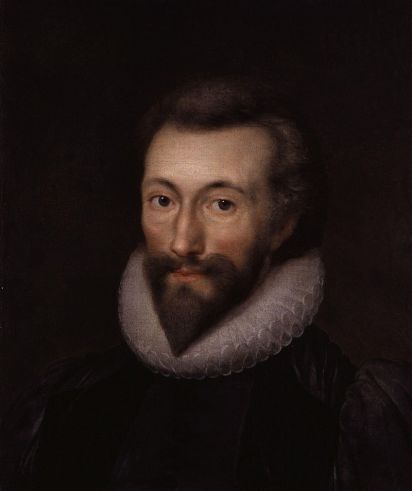 John Donne
John Donne was an English poet, scholar, soldier and secretary born into a recusant family, who later became a cleric in the Church of England.[2] Under royal patronage, he was made Dean of St Paul’s Cathedral in London (1621–1631). He is considered the preeminent representative of the metaphysical poets. His poetical works are noted for their metaphorical and sensual style and include sonnets, love poems, religious poems, Latin translations, epigrams, elegies, songs and satires. He is also known for his sermons.
Donne’s style is characterized by abrupt openings and various paradoxes, ironies and dislocations. These features, along with his frequent dramatic or everyday speech rhythms, his tense syntax and his tough eloquence, were both a reaction against the smoothness of conventional Elizabethan poetry and an adaptation into English of European baroque and mannerist techniques. His early career was marked by poetry that bore immense knowledge of English society. Another important theme in Donne’s poetry is the idea of true religion, something that he spent much time considering and about which he often theorised. He wrote secular poems as well as erotic and love poems. He is particularly famous for his mastery of metaphysical conceits.


 The Write Stuff