
Taking a look at another of my very favorite poems today. This one is less about lyrical poetry and more about contemplation of humanity. It always made me stop and think, and I hope it will either bring back memories of your own school studies or introduce you to something you may not have read before. Either way, it’s a bit more profound than what I’ve shared to date, but it never hurts to stop now and then for a moment of contemplation, right?
NOTE: Because this is actually an excerpt from an essay, it has been presented as a poem in various formats over the centuries. This is my favorite, as far as line breaks are concerned, and I certainly prefer the version with today’s English, as opposed to the way it was spoken in the fifteen and sixteen hundreds.
No Man Is an Island
John Donne – 1571 – 1631
No man is an island entire of itself;
Every man is a piece of the continent, a part of the main;
If a clod be washed away by the sea, Europe is the less,
As well as if a promontory were,
As well as any manner of thy friends or of thine own were;
Any man’s death diminishes me, because I am involved in mankind.
And therefore, never send to know for whom the bell tolls;
It tolls for thee.
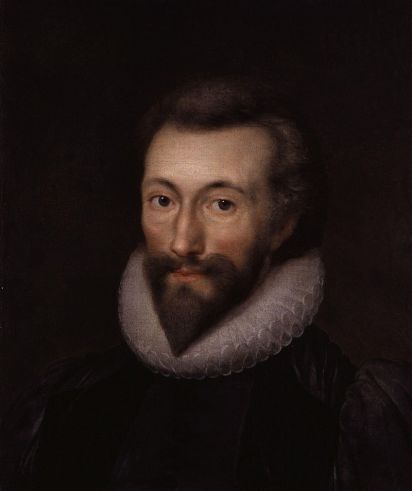 John Donne
John Donne was an English poet, scholar, soldier and secretary born into a recusant family, who later became a cleric in the Church of England.[2] Under royal patronage, he was made Dean of St Paul’s Cathedral in London (1621–1631). He is considered the preeminent representative of the metaphysical poets. His poetical works are noted for their metaphorical and sensual style and include sonnets, love poems, religious poems, Latin translations, epigrams, elegies, songs and satires. He is also known for his sermons.
Donne’s style is characterized by abrupt openings and various paradoxes, ironies and dislocations. These features, along with his frequent dramatic or everyday speech rhythms, his tense syntax and his tough eloquence, were both a reaction against the smoothness of conventional Elizabethan poetry and an adaptation into English of European baroque and mannerist techniques. His early career was marked by poetry that bore immense knowledge of English society. Another important theme in Donne’s poetry is the idea of true religion, something that he spent much time considering and about which he often theorised. He wrote secular poems as well as erotic and love poems. He is particularly famous for his mastery of metaphysical conceits.


 The Write Stuff
Beautiful!
Mark and I often used to pass John Donne’s house on one of our favourite walks, which was near where we lived at the time. https://www.geograph.org.uk/photo/342245
Curiously, Ripley, a tiny village in Surrey, is also where Eric Clapton’s mum ran the post office for many years!
LikeLiked by 2 people
Wow, Jackie! How wonderful to have lived near such interesting sites, and the picture is marvelous. Thanks so much for stopping by today, and taking a moment to say hello and share your experiences! Have a super week, and happy travels! 😀 ❤
LikeLiked by 1 person
Truer words were never written. Thanks, Marcia.
LikeLiked by 2 people
I agree, Olga, and wish more people recognized that thought. Glad you enjoyed today’s post, and thanks so much for stopping by to let me know. Have a great week! 😀 ❤
LikeLike
The first line of Donne’s poem is often used. And it is so true.
The whole verse is deep and thought provoking.
Thank you.
Miriam
LikeLiked by 2 people
I’m glad you enjoyed reading an old favorite, Miriam, and I agree with you 100%. I never tire of reading this one, and yep, it always provokes thoughts to ponder. Thanks for stopping by this morning, and here’s to a great week ahead! 😀 ❤
LikeLike
It definitely does make you think. Thanks for sharing, Marcia 🤗💕
LikeLiked by 2 people
It sure does, Cathy. No matter how many times I’ve read it over the decades, I always stop and reflect on the essential truth of this. Glad you enjoyed today’s offering, and thanks so much for stopping by and taking a moment to share your thoughts. Hope you have a fantastic week ahead! 😀 ❤
LikeLiked by 1 person
Thanks Marcia, hope you do to! 🥰
LikeLiked by 1 person
Those few short lines pack a huge emotional punch. I’ve loved this one since I first read it and it’s no surprise that both the first and last lines have been used for novels that express our need for each other in both personal and global terms. Another terrific choice, Marcia. ♥♥
LikeLiked by 1 person
You are so right, Trish! Such powerful lines, and SO much impact delivered with so few words. This will always remain one of my favorite poems of all time, maybe #1 in many ways, though I have others I like as much for different reasons. So glad you enjoyed today’s choice, and thanks so much for taking the time to share your thoughts. Hope you have a wonderful week ahead! 😀 ❤
LikeLiked by 1 person
And the same to you, Marcia! ♥♥
LikeLiked by 1 person
Thanks for sharing, Marcia. I’ve always liked John Donne and this is one of my favorites.
LikeLiked by 1 person
He certainly had an amazing way with words, didn’t he, Jeanne? So glad you enjoy his works, and I really appreciate your stopping by to share your thoughts on this talented poet from so long ago. Wishing you a wonderful week ahead! 😀 ❤
LikeLiked by 1 person
An amazing poet! I had an amazing high school English teacher too. We studied Donne, read For Whom the Bell Tolls, and studied a pop song with one of Donne’s lines in it back-to-back, drawing a connection between the three of them.
LikeLiked by 1 person
I’m glad you enjoy Donne’s work, too, Vera, and wow, what a great way to present it, in a combo of studies like that. I’ve always loved this poem and thought it one of the most profound works I’ve ever read. Thanks so much for letting me know you enjoyed the post today, and a little trip down Memory Lane, too. Hope you have a fantastic week ahead! 😀 ❤
LikeLiked by 1 person
There aren’t many adults who wouldn’t recognize the last couple of phrases from this poem, Marcia. I agree entirely with Donne that no man is an island. No person wins or fails entirely by his own efforts. We’re all connected and all responsible.
LikeLiked by 1 person
Exactly so, Diana. I’m glad you enjoyed today’s post and fully see just what Donne was saying in his unique and profound way. Thank you for stopping by today, too, and taking a moment to share your thoughts. Wishing you a wonderful week ahead, my friend! 😀 ❤
LikeLiked by 1 person
❤
LikeLiked by 1 person
Donne’s words are so profound and so insightful. What a kind and empathetic man he must have been! Thank you for sharing his wisdom, Marcia. 🙂
LikeLiked by 1 person
He certainly hit the nail on the head with this one, didn’t he? Even all these centuries later, his words still ring true. Glad you enjoyed today’s Classic Poetry, Nancy, and thanks for stopping by to share your thoughts. Have a super week ahead! 😀 ❤
LikeLiked by 1 person
I love the profound truth in this poem. We are all on this sinking ship together. Thanks for sharing, Marcia!
LikeLiked by 1 person
You got that right, Jan. Isn’t it interesting that all these centuries later, Donne’s eloquent expression of this truth is still valid and resonates with us loud and clear today. (Interesting and scary, both!) Glad you enjoyed reading one of my favorites from my long ago youth, and thanks for taking the time to share your thoughts on it. Hope you have a great week ahead! 😀 ❤
LikeLike
Silent contemplation is never a bad thing. Thanks for sharing, Marcia. Beautiful.
LikeLiked by 1 person
I agree, Sue, and you’re very welcome. This is a poem that has stuck with me for decades, and I was happy to include it in this series. Thanks so much for stopping by and taking a moment to weigh in on this subject. Hope you have a wonderful week ahead! 😀 ❤
LikeLiked by 1 person
Nice!
LikeLiked by 1 person
I’ve always loved it, Jennie, and I’m glad you enjoyed it today, too. Thanks for stopping by to let me know, and here’s to a great week ahead! 😀 ❤
LikeLiked by 1 person
You are welcome, Marcia. Best to you! Happy week ahead. 😀
LikeLiked by 1 person
I love John Donne. Before I retired, I worked in a campus police office. One of the officers found a copy of Death be not Proud at an event. They assumed it was a threatening note written by a student. When I came in the next morning, they wanted me to track down the schedule of classes for a student named John Donne. I informed my boss that it would be difficult since the person had been dead for several years.
LikeLiked by 1 person
Oh, my! That’s sad and funny at the same time. Tsk. I can’t imagine not recognizing the name of John Donne, but then again, times have changed, I guess. Still, for anyone who takes a moment to read this poem, it has to strike a nerve, I think. At least, I hope! Glad you enjoyed it and appreciate Donne and his work. Thanks so much for stopping by and taking a moment to share your thoughts. Hope you have a great week ahead! 😀 ❤
LikeLiked by 1 person
Unfortunately, the officers on campus didn’t read much.
LikeLiked by 1 person
Their loss! 🙄
LikeLiked by 1 person
Reading this poem brought back memories of my poetry classes at University. What a lovely, warm feeling. Thanks, Marcia. ❤
LikeLiked by 1 person
So glad you enjoyed it, Carol, and that it brought back special memories. I was introduced to John Donne somewhere around 12 or 13 years of age, in Junior High English, and this one in particular has always stuck with me. Thanks for taking the time to stop by and leave a comment, and I hope you have a great week ahead! 😀 ❤
LikeLiked by 1 person
Thanks Marcia.. I have always loved this poem and what a forward thinker John Donne was. If only world leaders and factions within our multi-cultural society would understand that beneath our skin we are all the same and do far better when we work together. A timely reminder ♥♥
LikeLiked by 1 person
John Donne was definitely a forward thinker, Sally, though it seems that many of humanity’s failings are the same today as they were centuries ago. *sigh* Still, he had a wonderful way with words that can inspire us to do better, if we just listen and learn.
Thanks so much for stopping by today and sharing your thoughts with us. Hope the rest of your week is a great one! 😀 ❤
LikeLiked by 1 person
You too my friend.. ♥
LikeLiked by 1 person
It is such a profound passage, Marcia. Like you I do love to contemplate. Xo
LikeLiked by 1 person
It is definitely profound, for sure, Denise! I’m glad you enjoyed the post and perhaps a bit of contemplating, too. Thanks so much taking a moment to share your thoughts, and here’s to a great rest of the week! 😀 ❤
LikeLiked by 1 person